02/15/2023 take wing

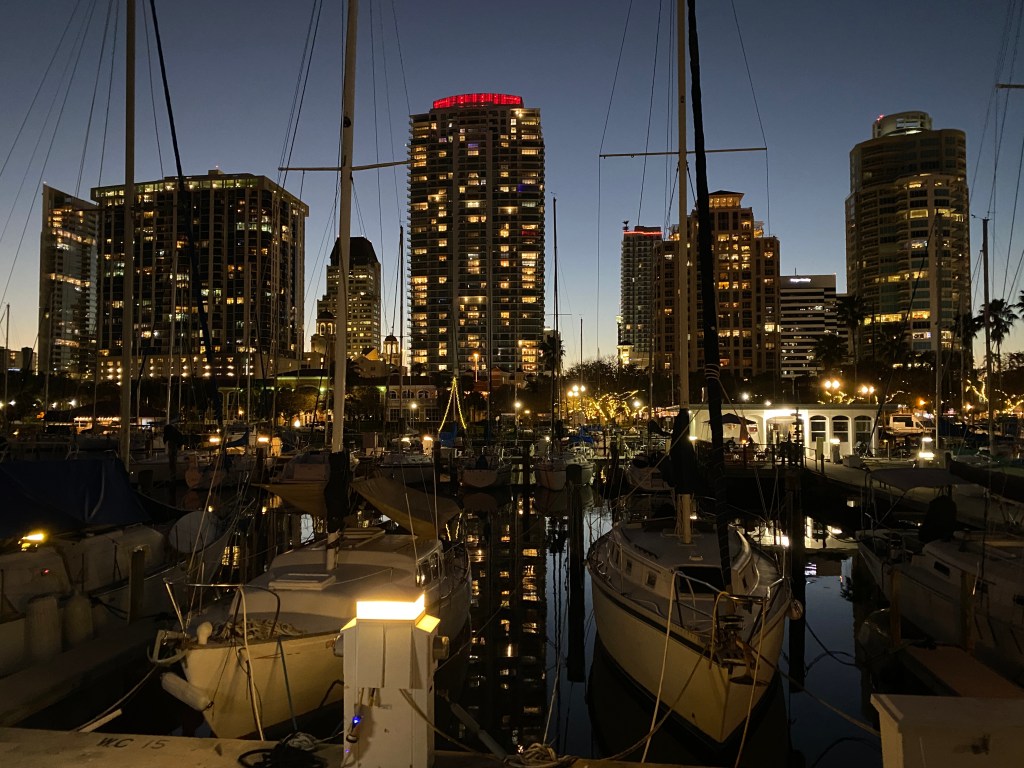
Yesterday, Valentine’s Day, we said good-bye to our home dock at the St. Petersburg Municipal Marina. We won’t return.

Last night we anchored where Tampa Bay meets the Manatee River. This morning I took a long last look across the Bay to Pinellas County, our home for the past eighteen years. That’s longer than I’ve lived anywhere. I hated it when we arrived in 2005. Now, I have tears in my eyes.

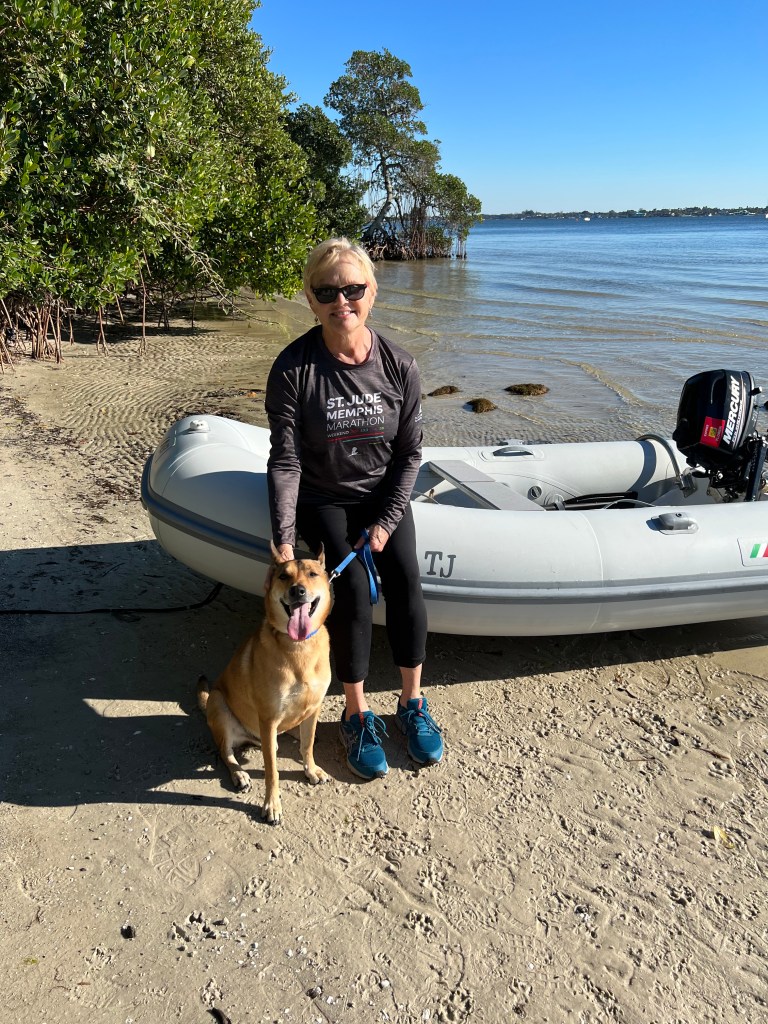
Early this morning we dinghied Looper ashore for a walk through Emerson Point Preserve, a birding sanctuary and home to the Portavant Mound. Portavant is one of many indigenous temple mounds in Florida. Looper yanked his leash impatiently, not buying our explanation of leash laws and nesting sites.

We hiked around the temple mound. I wondered about the Safety Harbor people who built it and the archaeologists who can read history through middens shards. By 900 AD, the Safety Harbor culture displaced the Manasota, who’d been there for 1400 years. The mound also holds Caloosahatchee and other Mississippian artifacts. By the end of the 18th century, these cultures were almost a thing of the past.

Now, Emerson Point is a bird sanctuary — without a whole lot of birds. I imagine Florida’s flocks and rookeries before Europeans arrived with their thirst for gold, conquest, and Christian converts.

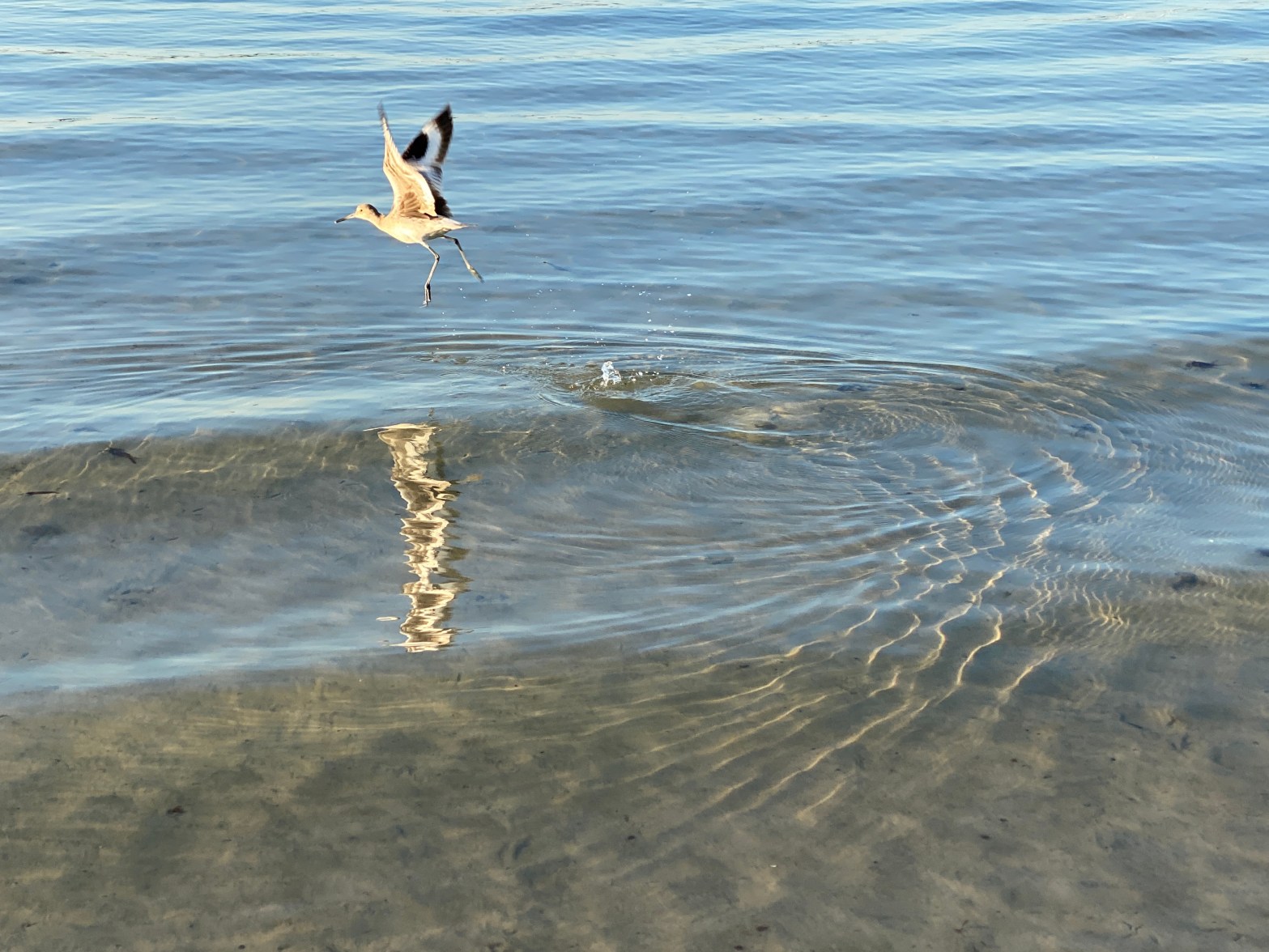
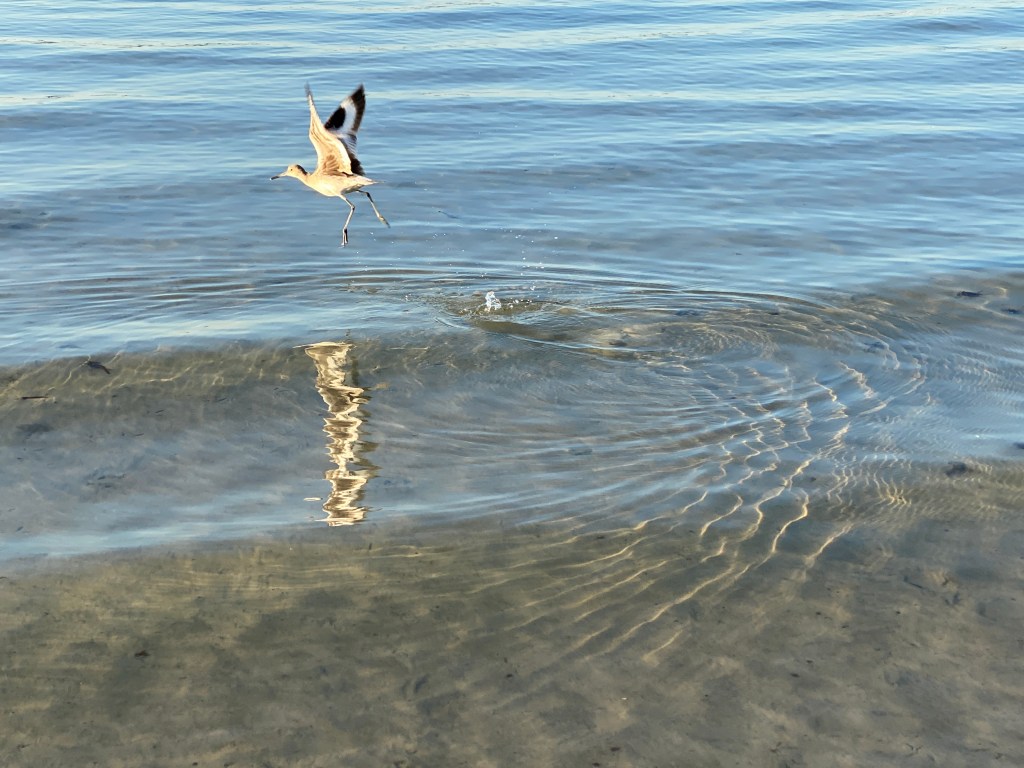
Back at the beach, we startled Eastern Willets foraging in the shallows. I caught one on camera as it lifted its graceful black-and-white wings. Its long legs stretched out as it flapped and splashed into the morning.

The National Audubon Society says when a willet stands on the beach it “is simply a large plain shorebird; but its identity is obvious as soon as it spreads its wings.”

This seems a fitting description of Pete, Looper, and me as we weigh anchor and head south toward Fort Myers, the Caloosahatchee River, and the Okeechobee Waterway that will carry us to the East Coast. We, too, are large and plain on land, but when we spread our wings – or a wake astern – we seem to find our best selves.

3/19/19 leaving georgetown


Where does maritime knowledge come from? Or the desire to go to sea?

Australian archaeologist Michael Morwood showed that Homo erectus navigated open water 800,000 years ago. Polynesians began to island-hop circa 3000 BCE. Everything we know about seamanship ties back to those first mariners. Odysseus sailed home to Penelope after the Trojan War, which was fought in the 12th century BCE.

But the desire to sail into the unknown? To discover what lies beyond the horizon? I think about my Dutch blood. And my one maternal line that traces to Scotland’s Outer Hebrides — the same line that settled in the Canadian Maritimes and eventually sailed on the Great Lakes. I think about myself growing up in land-locked Ohio pretending corn fields were oceans.

Thoughts like these rolled around my head the day Pete and I boarded Sea Tiger, fired up the diesels, and prepared to leave Harbourtown. Pete maneuvered our new-to-us boat off the dock. I took in her six lines as the dockhand passed them up. My pulse literally quickened.

We waved good-bye to the Colonial Era waterfront and the giant shrimp sculpture in the waterfront park as my boat-driving husband turned us down Winyah Bay. I sat at the forward bench and patted Sea Tiger’s windshield. “Say aloha!” A stiff wind took away my words and Georgetown’s rotting paper mill odor.

We were heading east to head south 850 statute miles toward St. Petersburg and home. Rule of thumb is one hour of car traveling equals one day of boat cruising. Pete was expected at work there in three weeks. We should be fine.

We would take the Intracoastal Waterway to South Florida, west across the Okeechobee Waterway — a river-lake-canal-river route that skirts the Everglades and connects Florida’s Atlantic and Gulf Coasts between Stuart and Fort Myers — then north to St. Pete.

The Intracoastal – ICW – is a ribbon of tidal rivers, canals, inlets, and bays that snakes 3000 miles from Norfolk Virginia, to Brownsville, Texas. It carries vessels mostly inside the barrier islands protecting the Southeastern U.S. coast from the ocean proper. I had been across ICW drawbridges countless times, often getting stuck as a boat sailed through the open draw. Always impatient because I didn’t want to be slowed on my way to the beach, to work, or home while sun-tanned boaters leisurely waved cold drinks toward the backed-up traffic.

Until now, I hadn’t been on the boat side of the equation.

Indeed, most of my time on the water had been spent on large ships. Constitutionally, I was sailor to Pete’s boatman. A sailor plies the high seas under power – or sail. Boatmen use smaller, lighter craft that stick close to shore. Pete has plenty of time on large cutters, too, and we’ve both sail-sailed, as in boats powered by the wind. But yeah, I was a sailor to his boatman.

Pete turned the helm over to me halfway down Winyah Bay, a long reach of the Atlantic that connects Georgetown with the sea. With his help, I sorted the channel markers and turned into the ICW at the correct time. But suddenly, the fast-running ebb tide swung the stern toward the opposite bank – a swung sharpened by the now crosswise wind that caught the bridge canvas like a giant sail.

He barked. I yelled back, overcorrected then overcorrected the other way. Finally straightened Sea Tiger out. Ahead of us, the ICW was a desolate, narrow ditch that low tide had left visibly shoaled on either side. A sailboat motored down the channel in front of us – without a radio, I quickly discovered. I lost maneuverability in the area’s no-wake slow zone.

*****

That first big course change I made happened in seconds, maybe a minute from the time I spun the wheel until we were steadied up and I was calling the sailboat to arrange passage (to no avail). In those moments, my romantic human experience/ DNA/ bloodline theories of maritime knowledge and desire evaporated. What did I know, really? What did I know? What did I not know?

I did know how to use engines and rudders to maneuver a vessel. I did not know how to balance those forces without a bow thruster.

I did know how the wind and tide can drag a boat off its intended course, how rapidly a boat can ground, and how difficult it can be to maneuver at the slow speeds dictated by a narrow channel and other traffic. I did not know how quickly and dangerously that could happen in a narrow, shallow channel on a lightweight boat with limited power and small rudders.

I did know that red aids to navigation pass down a vessel’s starboard (right) side when returning from sea or southbound in the Intracoastal Waterway; that green aids mark the opposite side. That ICW aids carry yellow marks to distinguish that channel from others.

I did not know how difficult it can be to find your course when those same red/ green/ with/ without yellow/ harbor/ ICW buoys and lights converge as they mark intersecting, crisscrossing, poorly defined channels.

I did know the International Rules of the Road and how to arrange passage with another vessel by radio. I did not know that many small boaters do not own or regularly turn on their VHF-FM sets.

And so much more. You don’t know what you don’t know. For me, that first day was a dawning, not the measure of my knowledge or lack thereof.

We traveled 66 miles to Charleston, arriving around sunset. I’d imagined celebrating St. Patrick’s Day under the fat, full moon that rose as we moored at the City Marina’s new mega-dock. But we were both too tired to do more than grab dinner at the restaurant at the end of the seemingly mile-long city dock.

****

Two or three times that day, Pete had edged us carefully through shoaled Low Country channels the full-moon tide had nearly emptied. I would not have dared. He’d motored us past a red buoy (with yellow square) lying on its side on a mid-channel island, left high and dry in the ebb. My heart was in my throat.

He drove us across Charleston Harbor’s windy expanse as I tried to track bustling Saturday afternoon boat traffic at the same time I figured out which buoy was which, which set of markers would carry us across the harbor, or back into the ICW, or up the Cooper River, or toward Fort Sumter, or into the Ashley River where we wanted to go.

I was sobered though didn’t yet feel the weight of the coming six years. I photographed the moonrise and thought about how cool it was to have our own boat, to be on it, to be going where we wanted to go instead of sent off on some or another mission.

I thought about my fourth-grade artwork, which Dad had recently returned to me. There, in my Palmer Method cursive I had copied Richard Hovey’s The Sea Gypsy. The lined schoolgirl paper is glued to a drawing I made over and over as a kid: a clipper ship, a dock, a sun. A silhouette figure, which can only represent me, standing close enough to touch the bowsprit.

Maybe it is in my DNA. Not the knowledge, of course, which only comes with experience and work – but the desire. How else would a girl from Orrville, Ohio, know from day one exactly where she wanted to go?

The Sea Gypsy
by Richard Hovey

I am fevered with the sunset
I am fretful with the bay
For the wander that is in me
And my soul is in Cathay.

There’s a schooner in the offing
With her topsails shot with fire,
And my heart has gone aboard her
For the Islands of Desire.

I must forth again tomorrow!
With the sunset I must be
Hull down on the trail of rapture
In the wonder of the sea.

3/14/19 a good boat

Are there good boats?

Sea Tiger seemed like a good boat. Notwithstanding the Clemson logo on the salon doors and orange tiger-paw on the boat’s transom. I’m a Georgia Southern alumna – I can say things about the Big C. The logo would have to go, I thought as I studied the boat’s listing on Yacht World’s website.

But the boat itself seemed good. Her hull sweeps gracefully from the waterline to the pulpit. She has 360 walk-around decks. Her rails gleamed. Her canvas and isinglass were (and are once again) new. Twin screws, twin rudders, reliable diesel engines. A boat that can take some seas.

I showed Pete the listing. “This one seems good,” I said. It’s huge, he said flatly. “Yeah?” I said, “If you want me to live on a boat, it’s not going to be a thirty-foot trawler.” I thought of my desktop computer and imagined myself typing essays while we cruised glinting blue waterways under sunny, rainbow-filled skies.

***

A few weeks later, in February 2019, we drove up to South Carolina to take a closer look. Sea Tiger had decent electronics and an immaculate engine room. Tons of space. A walk-around queen bed. Washer-dryer, full-sized refrigerator, two heads. Plenty of room for guests. A wide swim platform equipped with a freshwater hot and cold shower. The view from the bridge was (and is) great.

During sea trials, the boat got up to 22 MPH. We had to yell over the February headwind and diesel roar. But that was nothing new – we both served aboard big, fast, seagoing Coast Guard cutters and were used to it.

Inside, the boat was immaculate. Her owners had cleared out their stuff. Sea Tiger was a Navis Rosa, a clean slate, ready for new adventures. She bobbed gently and swayed a little as the Sampit River swept past Georgetown’s 300-year-old waterfront.

She had just completed the Great Loop so her air draft at 19’ had proven able to clear under all of the route’s bridges. Before that, she’d been a dockside retreat in Georgetown, for mostly absent owners.

She felt like a good boat. 

***

Every vessel is fingerprinted by its natal boatyard’s latitude and longitude, its keel heading during construction, materials used, and specifications. Every vessel is as unique as a baby and ages into itself based on its experiences. The aging process imprints energy onto the boat in both visible and hidden ways.

Outwardly, you see dings and scrapes where a dock landing was a little hard, for example, or a brown ICW mustache after she’s cruised inland waters too many days in a row, or rust stains where even the finest stainless steel is losing the war against the elements. Or new canvas, paint, or fixtures.

Inwardly, the boat carries another story, of its ghosts. Like many mariners and boatmen, I am superstitious. I believe this is true.

A vessel carries the words and attitudes of past and present captains and crews. The moods of parties and tragedies. The effects of sunshine over and dark waters under the bridge. She carries the energy left by heroics, adventures, and sorrows. She absorbs climate and weather, anchorages and marinas, hurricanes and starry nights. 

You can feel it when you step aboard.

“This is a good boat,” I said to Pete after Keith and Kay had left us alone. “It’s not that big,” he said. “Yeah,” I nodded.

We signed the papers a month later, on Pi Day, March 14, 2019.

 “We’ll take good care of her,” I said after the four of us posed for a snapshot and Pete and I and Keith and Kay hugged our good-byes. It was a raw, windy day in South Carolina. Kay said, “It’s bittersweet.”

“I know,” I said, thinking of the last boat my family owned, a 25-foot Catalina sailboat we’d had to leave in Puerto Rico when we transferred back to the States. She and I turned to look at the admittedly big Carver 445 that Pete and I now owned. I shivered in the wind.

***

I imagined we’d keep the boat for a year or two. Three on the outside, depending on when Pete retired and we could cruise in earnest.

Our plan was to sail the boat back to St. Petersburg and cruise locally on weekends or short trips down to the Keys or up to Florida’s Big Bend and Panhandle when we had a week or two off. That way, we could practice living aboard in close quarters. Looper, our trauma-rescued and sensitive Carolina dog could get used to being underway. The cats could adjust to Julie, the house-sitter.

We’d rechristen her as the Irish Hurricane – an old, politically incorrect, and ironic nautical term for an overcast day with drizzly skies and no wind, the opposite kind of day most boaters want to be out on the water. Weather Pete and I love nonetheless because we are quiet people.

A name we love because we are prone to Irish Exits, slipping away unnoticed from a party, meeting, or other assembly.

A name we love because rowdy boaters think it’s some kind of powerhouse alcoholic beverage which earns us a lot of hoorays from other boaters, particularly in Florida on St. Patrick’s Day.

Our plan was to cruise America’s Great Loop in 2021, from Florida to Northern Ontario’s storied and beautiful Georgian Bay before heading south through Lake Michigan, Chicago, St. Louis, then back to the Gulf of Mexico and home. 

Then we’d put her up for sale. 

That was six years, 20,000 statute miles, and – I’m not going to lie about this – a whole lot of dollars ago. Before Covid. Before we installed radar and auto helm and a bow thruster and a better swim ladder and new propellors and shafts and cutlass bearings and isinglass and screens and canvas. Before we took her through locks 200 times.

Before my mom and brother died. Before I got a new shoulder and new hip. Before Hurricanes Ian and Helene and Milton. Before Looper died and Katie came aboard. Before one cat ran away and the other one died. Before Julie moved on and Awilda and Kenny and Ricky came then left again.

Before the sunny September day outside of Montreal, when I was driving. Nearby Canadian boaters turned to see IH’s name – which they cheered in French. Someone noticed the wife at the helm easing IH’s graceful sweeping hull toward the lockwall, the pulpit almost over their heads in the small, crowded space – which they filmed as the women among them cheered even louder.

Six years ago, before I earned my USCG 100-ton Captain’s license. Before we moved back to Georgia. Before we decided it was time to close this book. Before we left our own story on IH’s.

Before we knew she is indeed a very good boat