5/17/2025 Seatow

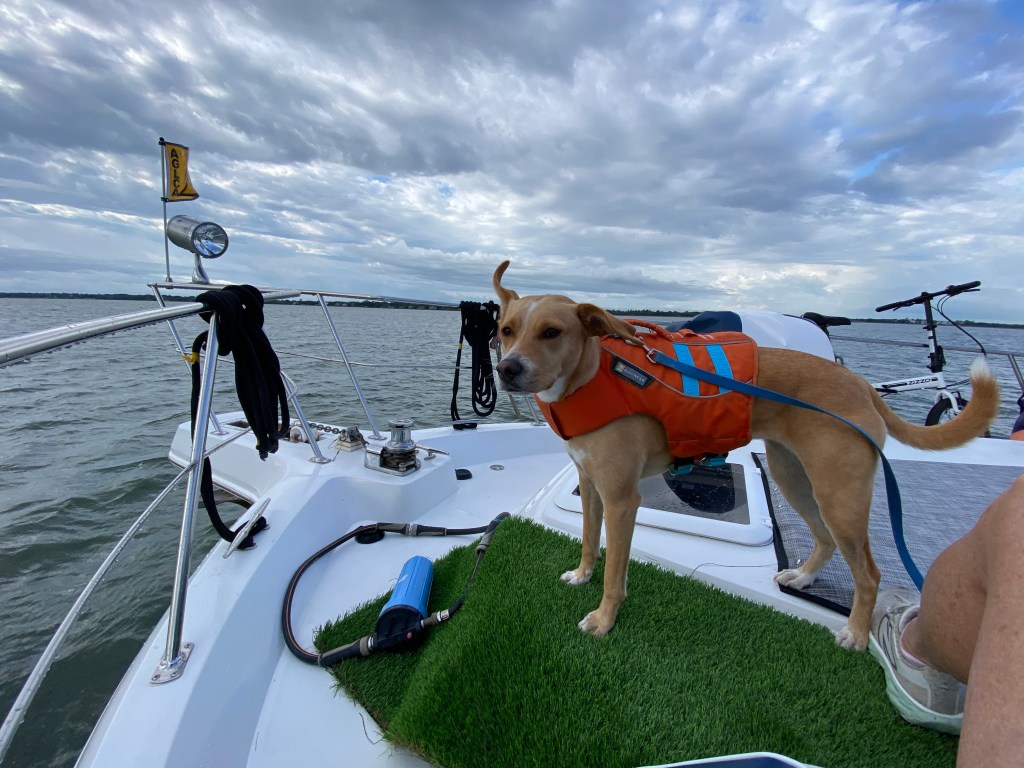
This morning we finalized plans to go nowhere fast. Our next stop will be Mile Hammock, a popular anchorage adjacent to Camp LeJeuene near Onslow Beach. Anchorage means taking Katie ashore in the dinghy. Turf training is a failure so far.

High winds are predicted today and tonight. Katie’s been in the dinghy once, on a flat, calm, sunny afternoon in the St. John’s River a year ago A wind-rough anchorage with no place to cut loose ashore is not an ideal first-for-real experience. So we’re holding off a night hoping for calmer conditions.

An extra day at the dock is good.

*

Yesterday afternoon we visited the lovely Cape Fear Yacht Club for cocktail hour. Local boaters welcomed us warmly. We found excellent company in our dockmates — Loopers on our starboard side and Yacht Club members on our port — and YC members who regaled us with advice and stories of the sea.

I think of Masefield’s Sea Fever
And all I ask is a merry yarn from a laughing fellow=rover…

One of those rovers graciously drove me to and from the Food Lion this morning. IH was low on more than I thought — why is it the aisles remind you of what you are running low on?

All in all, fellowship like this makes us feel like we’re in sharp, trustworthy company. That someone is there. That Pete, Katie, and I are never alone.

*

SeaTow was casting off as Katie and I left for her run this morning. Engines fired up. Radio crackling.

Many of my Coast Guard friends will remember the furor created in the 1980’s when some near and dear Coast Guard services, like responding to disabled, grounded, or other not-life-threatening distress calls were turned over to commercial services. We thought the world was ending. It didn’t.

Now, I’m glad SeaTow and other commercial services are around. They fill the gray area between full-blown Mayday and a soft grounding, for example. Indeed, we’ve called SeaTow on the phone and radio to check local conditions. They know where people run aground. They have great local knowledge and have always generously shared it.

*
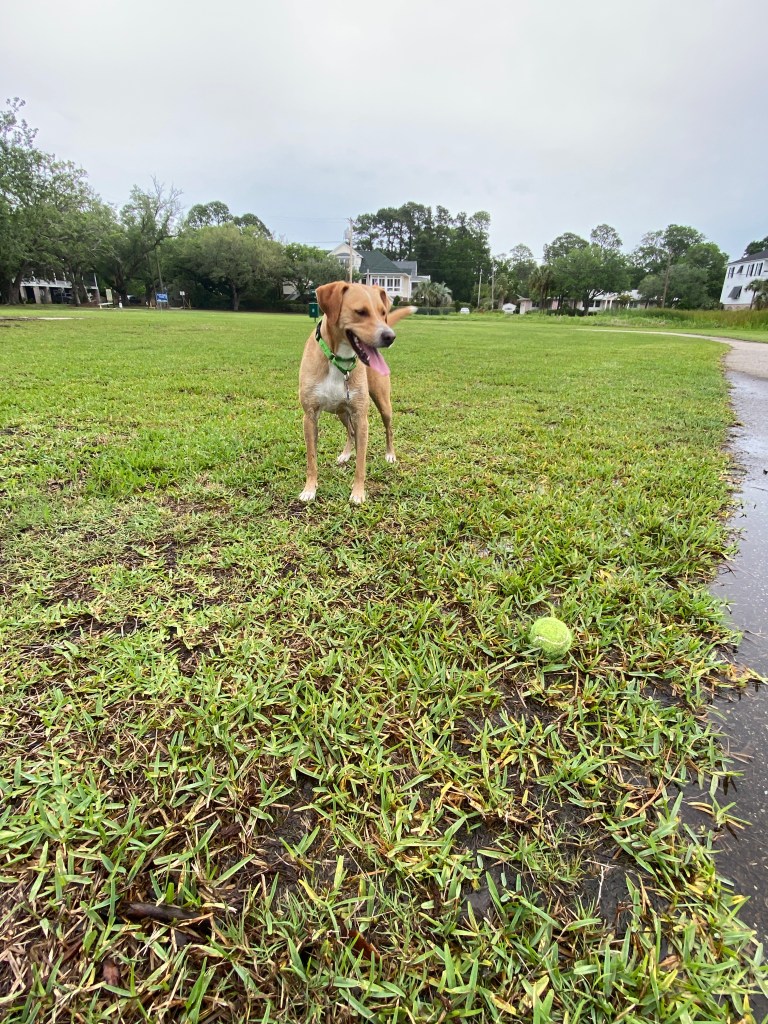
Katie’s learned to communicate her preferred go-fetch venue by carrying her ball there, dropping it, and staring hard at me. Today, she chose the crescent-moon river beaches where blue crabs had either washed up or been discarded after a picnic.

*

I spent the rest of the day reading. Like friendly locals or trusty salvage services, books are also trusty friends – until the virtual library returns its own novel from my Kindle to their shelves. “I’m at 82%,” I said to Pete, meaning, “Can you please cook dinner even though you already cooked breakfast?”

I couldn’t ask for a better shipmate or husband.

*

The sunset brought cooler breeze and low enough temperatures I ventured out to watch sunset from the bridge with Katie, who regularly perches here keeping an eye on things.

Judging by their playlist, I believe Rusty Hooks Dockside Grill is hosting Disco Night. Judging from the parking lot and the girls in dresses and platform sandals across the way, Disco Night is a hot local ticket.

Tomorrow we’re underway early.
5/16/2025 Yachting

Irish Hurricane is a 1998 Carver “aft cabin motor yacht,” a model series that belies our actual vessel, hard-pressed to be considered a yacht. Yacht comes from the Dutch verb jachten, meaning to hurry, hustle, or flutter. We cruise at eight miles an hour. You decide. Though this year we’re making a point to travel slowly and enjoy more as we go.

*

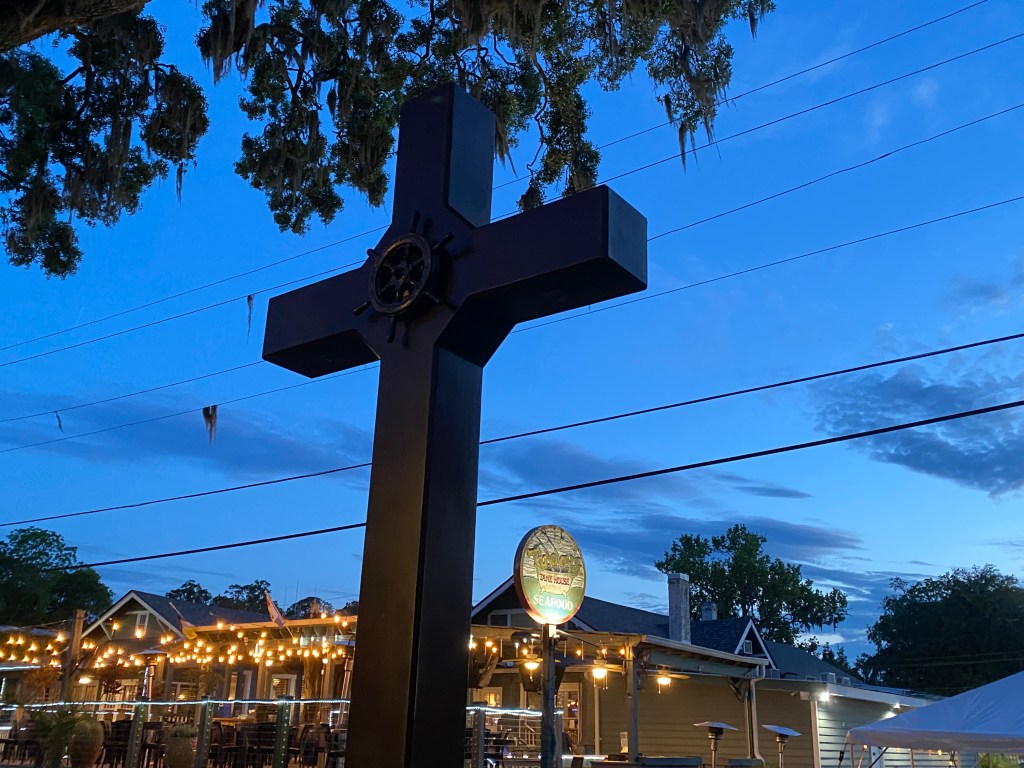
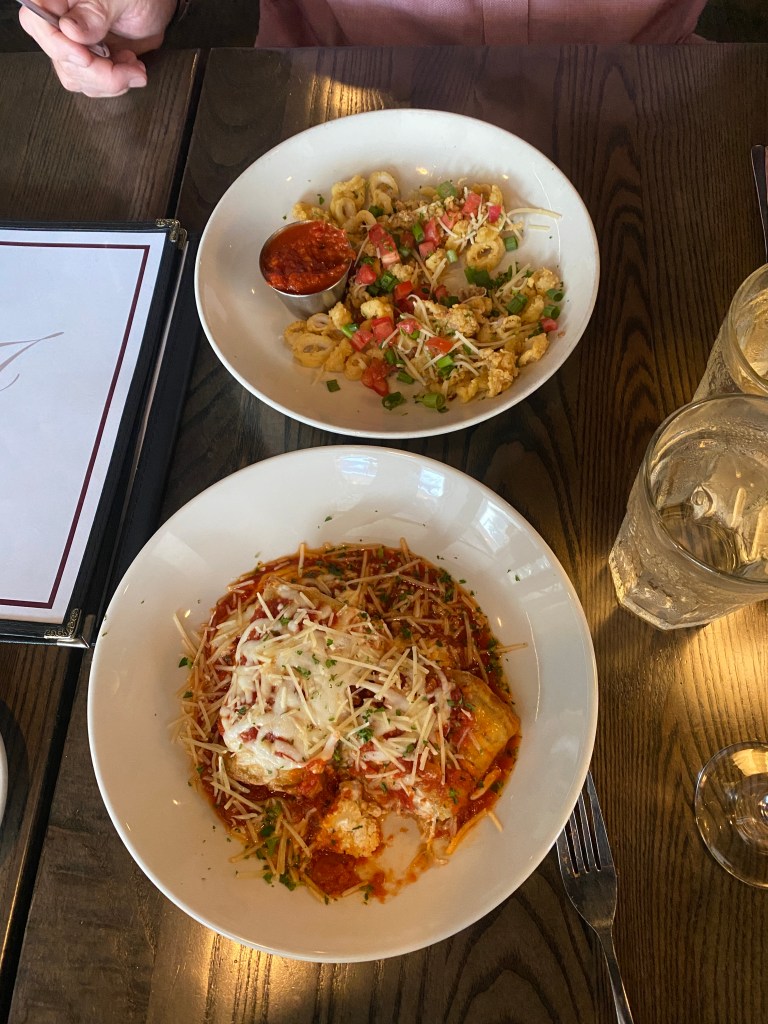
Last night we ate the rare meal out at Joseph’s Italian Bistro, steps from our dock. Everyone says it’s a must-experience. In this case, everyone was right. Even I knew the food was exceptional. Tender, lightly breaded calamari. Eggplant rollatini stuffed with ricotta, mozzarella, Parmesan, and herbs.

Bread nuggets so soft and light I wanted to cry. Fist-sized meatballs. Veal drifting in lemony sauce and capers. Desserts so rich they’re in our refrigerator until our food comas subside.

But like yacht, Italian carries its own images. I say, “We had Italian,” you get the idea. Not specifics – the devil’s always in the details – but the general idea.

*

When I hear yacht, I think of 1959’s Some Like It Hot starring Marilyn Monroe, Jack Lemmon, Tony Curtis, and the 121-foot luxury motor yacht Lovely Lady, built in 1930. She had classic wooden-boat yachty-sleek lines.

Her first owner was Townsend Irvin (ADM, USN, Retired), then-Commodore of the New York Yacht Club. Her last mooring was in the Miami River where she sank in 2009. Not yacht-like, but still.

*

Yacht makes me think of the schooner America, winner of the 1851 Isle of Wight competition. She sailed away with the Royal Yacht Squadron 100-Guinea Cup.

The British, whose yachts she’d beaten, claimed she cheated by shortcutting a corner, which she did. A court later ruled in her favor, because the existing rules didn’t say she couldn’t cut. I’m not sure that’s how I define not cheating.

She never competed in the race again. Her syndicate deeded the RYS Cup to the New York Yacht Club in 1857 (when it was renamed America’s Cup). NYYC syndicates went on to hold the Cup for 132 years. When they finally lost it in 1983, it felt like America had been cheated out of something.

*

America eventually served the Confederate States Navy, the Union Navy, and the U.S. Navy — her final caretaker, who let her rot at the dock until they scrapped her in 1945. She is one of only four U.S, vessels that were in commission during both the Civil War and WWII.

*

Carver originally advertised their Aft Cabin Motor Yacht with bikini’d girls standing on the flybridge, long hair streaming in the wind while the hull cuts a brilliant wake through cobalt water.

IH still bears her design marks. She has mauve laminate in the aft head, a pop-up jewelry drawer under lighted mirrors, and pleathery ruched dinette cushions. I like to Google yacht interior design and dream. I never see rouched pleather or mauve-and-turquoise color schemes.

Nor would I consider Pete, Katie, and me to be playboys.

*

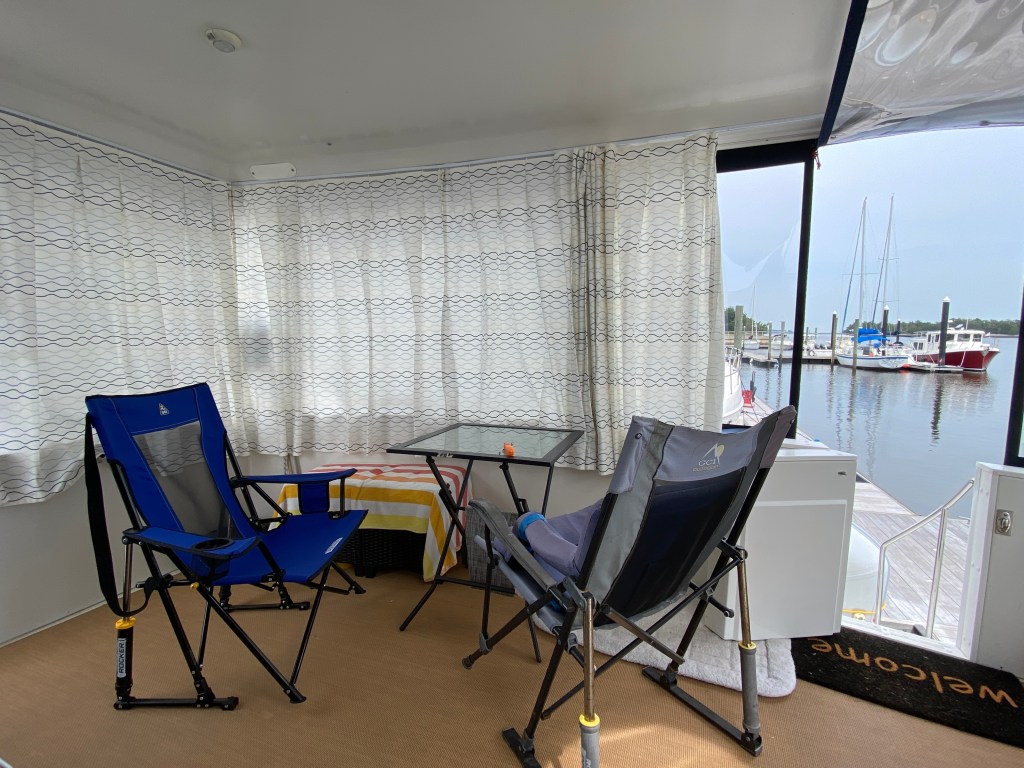
To me, yacht suggests billionaires tossing money around while peons keep their vessels shipshape. Aboard IH, it often feels like the boat is the billionaire, immune to our budget, and the two of us her underpaid workers. Today, Pete broke out his heavy Sailrite machine and sewed awesome sun deck curtains standing at the pleather-seated dinette. It’s a heavy, sweaty job.

I cannot thank him enough. They will keep out blinding sun and heat, and afford privacy in crowded marinas. The curtains are Ikea hacks, which does not scream yacht.

Ikea call curtains lill, which means lily, and curtain systems Vidga, which means widen. Designs have feminine names.

Like most Americans, I am confused and blinded by Ikea’s gibberish. Using doublespeak is manipulative. It is done to make you think something is more then what it is, of obfuscating the truth. It’s a way of talking down to people. As though I should thank Ikea for the honor of purchasing lilies for my widened sun deck with a design that evokes waves named for the exalted Henny Rand, whoever she is.

*

So, when I say we live on a yacht, understand that’s not exactly the truth. It’s a word someone tossed out to make ordinary playboys look like billionaires.

IH is not wooden, has little luxury, is more big-boned than sleek, lacks sails of any kind, and, other than flying the stars and stripes, bears no resemblance at all to the schooner America which, I note, won a cup that did not bear its actual name.

5/15/2025 Flags

I’m not excited about walking Katie. It’s hot. I don’t do well in heat. I think about black flag days, terminology the military uses to indicate people are at risk for heat exhaustion.

Someone told Pete it’s ten degrees hotter than it should be this time of year. Fortunately, there’s a stiff, cooling, southwestern breeze. I lace up.

*

The wind comes from a semi-permanent climate feature offshore known as the Bermuda High. It’s an important thing, this high. It helps to steer hurricanes farther east or west, depending on where it sits when a storm is coming. 

The Bermuda High wanders back and forth across the Atlantic at varying strengths based on factors that similarly affect the entire globe’s weather: jet stream location, ocean temperatures, upper atmospheric conditions and the like.

*

On the way to Dutchman’s Park, I notice flags snapping on buildings and boats. A flag’s angle from its pole divided by four estimates wind speed. They’re flying at a sharp 80 degrees today, a 20 mph wind. It’s one way to read flags and weather.

*

Katie couldn’t be happier. The park has lawns and beaches. Another dog named Dorsey has her own ball though she’s resting under a piece of driftwood where it’s cool while her manservant fishes for croaker.

At the park, Katie runs and swims. Pete throws the ball. I dodge little crabs.

*

Irish Hurricane flies the national ensign, a term for a flag on a vessel indicating nationality. When we visit Canada, we fly the Canadian flag as a courtesy, a nod to their sovereignty. A way to show respect.

We also fly the AGLCA gold burgee to show we’ve completed the Loop. A burgee is a swallow-tailed flag about identity. A lot of burgees are only recognized by a few– yacht club flags, for instance.

*

Generally, the highest flag flown takes precedence. It’s bad form to fly anything above an American flag. If you’re an American.

One boat I saw this morning flew three flags. The top one looked like the U.S. Secretary of the Navy flag, blue with a white fouled anchor and four stars. I doubt whether SECNAV was aboard this boat. Would he run the Navy from Southport, North Carolina?

I didn’t recognize the middle flag, faded red with a logo, maybe a sports team. The bottom is universally recognized. Black with white skull and crossbones. The Jolly Roger.

*

We passed by flags either left over from a Cinco de Mayo bash or being used as Tibetan prayer flags. The former stand for hope, independence, unity, and the blood of Mexican heroes.

The latter represent compassion, peace, wisdom, and strength. Tibetans believe the wind carries words written on their flags to the benefit of all people.  

*

I saw a makeshift flag on beach debris I imagine landed on the riverbank after a flood or a hurricane set it free. 

A storm warning flag is square red with a center black square. Two together mean a hurricane is coming.  NOAA stopped raising hurricane flags after the rise of TV and radio broadcasts, though you can still see them flying in some places. Like bridge clearance boards, they’re low-tech.

Crosby, Stills & Nash sing, I have my ship, and all her flags are flying. Back aboard IH, I see ours are, too.

Now, Katie’s worn out and drying in the sun after being rinsed of salt and sand. Pete and I are inside the boat enjoying the a/c. A trawler just docked next to us. They’re flying an AGLCA white burgee.

I plan to stop by later, to say hello. I can see by their flag that they’re one of our own.

5/14/2025 Auto Helm

“I’m not going to hand-steer six thousand miles,” Pete said five years ago. Meaning, he wanted autohelm.

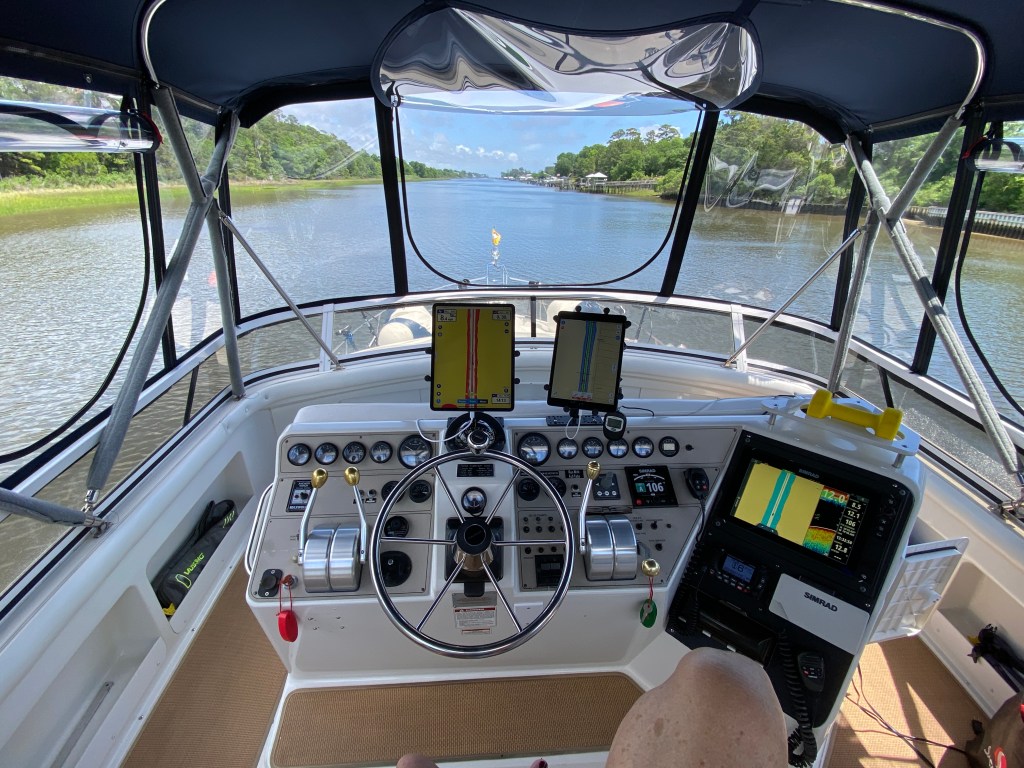
The installation required him to snake NEMA 2000 cables from rudders to bridge via small holes through inaccessible bulkheads. A lot of sailor mouth was involved. However, now Irish Hurricane can auto-steer a heading or course to make good, which are related but different things.

The autohelm is especially useful at high speeds, in heavy weather, and on long straightaways.

But the autohelm is only as good as its input, which means we’ll always be watchstanders, not bystanders. If I order it to steer across shoal water, IH will run aground. If I say make good a course that runs over a dock, someone’s property will be destroyed, including ours.

You still have to think.

*

The ICW between Myrtle Beach and the Cape Fear River is a straight, slow, tedious run. The narrow channel is lined with houses and condos — and docks. It is one long no-wake zone broken by a rough inlet and swing bridge at Little River.

*

I like the bridge because it’s old and pretty. I like the tender’s voice, which is soothing, patient, and kind. I envision a human when I hear her on the radio. A thinking person. Someone who’s not on auto.

Swing bridges pivot ninety degrees, often from the middle such that half of the bridge swings toward you and the other away. You need them opened if there’s not enough clearance beneath for your vessel to pass. If you’re too tall.

Charts show bridge clearances. Bridges post lower-tech but more reliable boards marked vertically in feet. If you can see, say, the number sixteen on the boards, the real-world water level gives you sixteen feet of clearance. Boards advertise verifiable facts. They can’t be hacked.

*

The Little River Swing Bridge was already opening today when I sighted it, a mile away, at the other end of a no-wake zone. I assumed the tender would close her bridge before IH reached it. I’ve had to hold there before, against some powerful, eddying currents, which is not not hard so I called on the radio.

She radioed back in her sweet Southernese, “Irish Hurricane, I see you coming. I’ll keep the bridge open for you, take your time.”

Surely, she knew traffic was backing up. But I imagine she considered other factors. 

The age of the bridge. Wear and tear. The fact of a viable alternate car route across the bridge. The current. The advisability of vessels holding against that current in such close proximity to other boats and docks.

When I was through the bridge, I radioed, “Irish Hurricane clear. Thank you so much.” I meant it.

*

Which brings me back to autopilot. It’s a great convenience. But living requires thought. We cede something important when we travel on auto. Sure, I have something or someone to blame if everything heads south. But in the end, wasn’t I the one who ordered the course and adjusted the speed?

That’s the problem with auto-anything. Autopilot, autohelm, autocrat.

*

Our Southport marina is two miles from the Cape Fear River and North Carolina’s Outer Banks. We left in sun. We arrived in sun, a 20-knot wind, and a half-knot ebb tide pushing. Now it’s dark and rainy.

Fingers crossed for Katie it’s nice again tomorrow. It looks like there’s even a beach here.

5/13/2025 Current Reverses

The first half of today’s 45-mile transit was in the Waccamaw River a few miles west of and parallel to the coast between Georgetown and Myrtle Beach. The second part of the trip was in a dredged channel heading northeast toward South Carolina’s Grand Strand.

Five miles south of where the dredged channel and Waccamaw River go their separate ways, a chart note said: CURRENT REVERSES. I’d been watching the river, gauging the depth and shoals, and checking my eye against the chart. I didn’t see the current reversal coming. Nobody could have.

The note – current reverses — reminded me of a literary device: reversal of fortune. Something happens to change a character’s luck for better or worse. She or he has to respond, make choices, hope for the best.

Today’s weather was a change of fortune. We’ve been in rain since Savannah. But today the sun shone brightly while a cool breeze blew the clouds and humidity out to sea.

Katie — whose leashed-walk fortune changed for the better yesterday at Georgetown’s park — got in another ball-chasing session early.

On the way back to the marina, I turned to take a photo of Front Street’s tunnel of live oaks, glistening under the morning sky. Its houses were washed clean, as some of them have been doing after rainfall since the early 18th century. One, since 1737.

But my phone was locked. The password I’ve used for at least a decade wouldn’t open it. I got the dreaded Wait 1 Minute prompt. I tried again after that minute, then after 2, then 4, then 15. Finally, my phone informed me I wasn’t myself. I was a security risk. It wouldn’t unlock at all.

My fortune had reversed for the worst.

Back at the marina, I stopped to wish friends well. Others were already gone. I took in lines. Pete drove out. Then I did what you do to make your phone work again. Support desk. Shut down this. Turn off that. Enter this. Restart that.

Finally, I was on the cusp of a fortune reversal for the better. But then we lost cell coverage and again it turned to the worst. I gave up electronics to take a breather at the helm.

*

The Waccamaw National Wildlife Refuge is one of my favorites. The trees begin to be more cypress and hardwood and less live oak and pine. It’s hard to tell exactly where you cross an invisible line between ecosystems.

It’s also hard to tell where you cross the line between the channel’s tidal currents and its river currents, water simply running downhill from the mountains to the sea. There’s a result – water is pushing you or dragging you back — though it’s not always clear why or which influence is stronger.

The chart note explained that north of the point current ran toward Myrtle Beach and south of it, toward Georgetown. Like fortune, it reverses without explanation, though I imagine someone somewhere has the answer.

*

Today, Irish Hurricane’s fortunes held. We reached Myrtle Beach safely. Pete put her right on the dock despite a stiff wind and lots of eddying current.

My phone is working at least as well as it was before my fortunes reversed this morning. It has a new password. Fortunately, everything it held was backed up to the cloud. Contacts, apps, old texts, and voicemails from people who are gone but I still love.

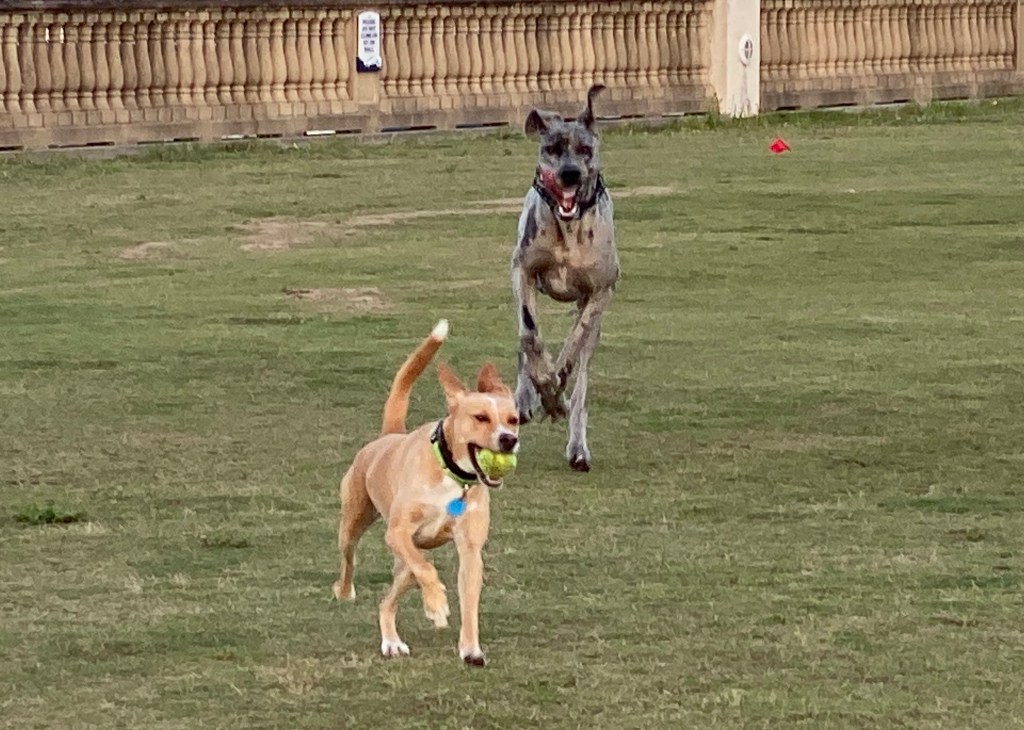
Katie’s fortune held. There’s an enormous dog park adjacent to the marina. There, she met an enormous Great Dane named Elvis which, despite his great size, was unable to keep up with Katie the Deckie.

She chased her ball until the sun set and the stars appeared. On balance, it was a very good day.

5/12/2025 Somewhere Out There

Today Katie ran, off the leash, after her ball, in a park big enough to satisfy her need for speed. She hasn’t gotten to do this for weeks. She reminds us of this fact by sitting on the boat and staring into the distance — the far distance — where, she’d like us to know, a big park surely exists where she can have some fun.

Today the park appeared: Georgetown’s Morgan Park, a peninsula bounded by the Great Pee Dee River, Sampit River, and Georgetown’s charming Front Street. Reason One to stop in this pretty Colonial-era town.

The park was soppy. Katie made it her business to drop the ball far enough from where I threw it so I’d have to get in a few steps to pick it up and reload it into the Chuck-R. She’d drop it in big puddles or, three times, in the marshes that line the rivers.

She was very pleased with herself doing this, making me work for it.

Maybe it was pay-back for the number of days when she’s had nothing but quick morning and evening walks given by her humans, who are unable to begin to run at her usual, say, twenty miles an hour. She ran this morning until she was exhausted then ran some more. She slept all afternoon.

*

Meanwhile, Pete found shrimp down on the docks at the Stormy Seas Seafood Market, a family-owned nuts-and-bolts store that purveys just-caught shrimp and fish. Reason Two to stop in Georgetown. Back on the boat, he peeled and deveined three pounds to share with fellow travelers at dinner: Reason Three.

Georgetown is one of the few marina stopovers between Charleston and Myrtle Beach. There is generally a fun crowd of cruisers and Loopers that stop here while making their way north in spring (or south in autumn). It’s easy to find people to hang out with. With the rain falling steadily, we opted for having people visit Irish Hurricane instead of all of us carrying food to the marina lounge.

I went to work straightening the boat.

*

Irish Hurricane’s salon is not what it once was. The L-shaped sofa has been replaced by a computer desk and recliner. Katie’s futon mattress-like bed folds into a semblance of a loveseat that is not very comfortable. Otherwise, there’s a desk chair and steps that can be used for seating in a pinch.

Nobody seemed to mind. Everyone brought something to share. Food, stories, and good will. Which is all any of us really want, someone to come and play. Someone to show up, add what they can, listen, and consider other ideas and points of view.

*

After dinner, we three ladies walked back to the park – the rain had stopped, and though night was falling, Katie was up for another quick round of throw-the-tennis-ball. She was joined by her new friend Trevor, a fine and patient black and white English shepherd, who did his best to herd her back in line while she zipped off after her beloved ball.

*

Everyone’s back at home now, on their own boat at their own slip. None of us are sure when we’ll see each other again. Or if. We are boats passing in the night – but aren’t most of us, whether we’re on a boat or not?

That’s okay. I think it’s enough to know there are people out there who know us at least a little bit. Who we’ve connected with and they with us. Sometimes it’s enough to be able to look to the horizon and imagine what our friends are up to, where they are, and that they’re doing okay. That our paths will recross.

It’s a kind of knowledge. Like Katie and her certainty that somewhere there is a dog park with her name on it. That one day, she’ll see it again.

5/11/2025 Reading the Water

”Chance is underway. So are Sweet Melissa and Panther,” Pete informed me a few minutes after 0800. I was dragging my feet. Storms in the night brought Katie to the Vee berth where Pete racked while I starfished my way across his side of our bed.

Heavy thunderstorms were predicted throughout the day along the track to Georgetown. But there’s safety in numbers. I took Katie for a short walk while he took in the shore tie and water hose.

By 0845 we were underway in Charleston Harbor for the 68 mile run to the 300-year-old seaport at the head of Winyah Bay. I swabbed the decks while Pete drove. Then Katie and I hung out on the bow catching the breeze.

The run north is a long ditch, dredged to 12 feet, though the channel is much shallower in places. The tidal rivers constantly shift sand and silt to rearrange the bottom.

I’m not great at reading the water so I rely on the Army Corps of Engineers overlay on the electronic Aqua Map, and something called Bob’s Tracks. Today, though, I also practiced the art of seeing as I checked my best guesses about the deepest part of the channel and the location and slope of shoals against the chart data.

Water is often deepest on the outside of a channel bend. Shoals build on the inside. And where creeks empty into other rivers or the channel. Sometimes shoals develop around pilings, like those that hold channel markers. Where currents meet, there is often a distinct line of flotsam. And so on.

*

It’s easy to become reliant on electronics. But when Georgetown was founded in 1729, a few years after Charleston, mariners relied on their ability to read the water — and weather, compass, sextant readings, and the positions and phases of the moon, sun, and stars.

They relied on the notes and knowledge of others who came before. Charts were only as accurate as the surveyors or cartographers who drew them up. If their readings weren’t good, if their information wasn’t properly vetted, the chart would be no help at all.

I studied the helm console as I drove Irish Hurricane through a couple of particularly narrow passages, talked to other boats on the radio to arrange passage, and checked the radar for rain and sonar for depth. I have advantages the ancient mariners decidedly lacked.

I played what-if. What-if I lose charting, or Bob’s blue dotted track, or Navionics’ magenta line, or anything else? Would I know what to do? What if a channel marker is destroyed, missing, or off station?

Could I simply read the water? I practiced looking away from the glowing screens, to focus on the environment. The water, the wind and types of clouds, the way IH and other boats and buoys were moving and being moved by propulsion, wind, and water. I want to be able to trust my gut.

I practiced mentally. I don’t obsess over the possibilities of losing modern conveniences. But I advocate thinking things through, knowing what I’d do if I had to step up and decide for myself.

Today, though, nothing went wrong. We reached Georgetown by 1645. It rained along the way, but not hard and not for long. We docked after Sweet Melissa. Chance pulled in after we did. Panther is moored on the other side of the marina shack, though I’m not sure when they arrived.

I took Katie for her walk, remembering Georgetown’s cool old houses. We’ll be here for a night or two, then continue north.

5/10/2025 Pilots and Pirates

Pete laid out the options as we drank coffee this morning under gloomy, windy, rain-soaked skies. Head north to McClellanville, a rural wind-swept fishing town tucked between the Francis Marion National Forest and the beautiful but remote Cape Romain; we’d likely be stuck there in weather for two nights. Or make a longer run in wind and rain to Georgetown — ditto being pinned down by weather through Tuesday morning.

Or stay another night in Charleston.

I love Charleston. No contest. Up Katie and I went to the marina office, fingers crossed. Hannah the Dockmaster and her assistant immediately took to Katie, who wormed with excitement and gladly took their Milk Bone.

Yes, our slip was available another night. I relayed the info back to Pete on J Dock, then Katie and I went walking.

*

We passed boys fishing in the marshes, wading birds, and tide-swollen grasses along Lockwood Drive before rounding onto Broad, Chisholm, then Tradd Streets. The Rice Mill looked abandoned, though Coast Guard Station Charleston is still housed there.

There is new construction along Murray Boulevard. I wonder if hurricanes – or time – finally took a toll on some of the beautiful old homes, The air was thick with the perfume of sweet tea olives climbing the old wrought iron fences.

The Riverwalk is under renovations along the Battery and in White Point Garden. Katie checked out squirrels. I checked out monuments.

*

There are more and older monuments to Revolutionary War heroes although the most prominent one honors Confederate soldiers. The comparison reminded me that It’s easy to get short-sighted when looking back through history. To see the nearer past rather than its longer reach. To feel the impact of recent events over the importance of those buried more deeply in the past.

Two hundred fifty years ago, the thirteen colonies fought bitterly and hard to throw off an authoritarian king who saw America as his personal possession, useful for fattening his own coffers and extending his empire. North and South, those thirteen colonies decided they would be indivisible. They stood up against tyranny.

One monument mentions the Swamp Fox, local hero Francis Marion for whom the national forest is named. There, he and his guerrillas melted away after striking time and again, and viciously, against British Loyalists. He inspired his men, had an excellent intelligence network, and helped America shake off the king.

According to americanrevolution.org, George III declared it his duty to “stand fast against the Americans in ‘the battle of the legislature’ and ‘withstand every attempt to weaken or impair” his sovereign authority. To deny Congressional authority and do everything possible to extend his own greedy power.

*

I reread another favorite monument, about the pirates Edward Teach (Blackbeard) and Stede Bonnet (The Gentleman Pirate), and their 39 crewmen who, after holding Charleston hostage in 1718, were finally defeated. Bonnet and others were hanged to death at a nearby gallows. Teach was later killed in a bloody battle near Ocracoke Island, NC.

*

Katie and I moved on to Stoll’s Alley, called Pilot’s Alley until 1745, for the obvious reason in a port city. Then up Broad Street and around Colonial Lake.

By the time she and I returned to the marina, I’d managed 10,432 steps and was covered in sweat. Back at the boat, she immediately found her ball for Pete and me to throw – in an arc from the galley over the salon into the aft cabin, and return.

Pete made an excellent dinner of ratatouille and fresh bread while I typed. Tomorrow we head out early – for Georgetown, where Irish Hurricane was a Clemson-logo’d dockside condo for many years of her life, before we rescued her and set her free.

There’s something to be said for freedom. Just ask her. She knows.

5/9/2025 Planning

Today, we planned to move thirty miles, from Hilton Head to Beaufort, South Carolina. Then, we planned to stay in Hilton Head, then decided to run 50 miles north to a favorite anchorage behind Edisto Island. Unless it was okay and we thought we could reach Charleston.

Today’s plan changes revolved around weather. There’s a big occluded front hanging over the SEUS from Florida to the Carolinas. The air in the occluded wedge is unstable, moody, and unpredictable. A low is also developing offshore. The weekend will be less than ideal cruising conditions.

In the end, we made it to Charleston where we took on fuel then docked as we watched a light show of cloud to cloud lightning approach from the west.

I’m glad we changed plans – that we paid attention to what was actually going on and didn’t argue with weather facts. I’m glad we’re able to flex our thinking, to not be rigid once we put together a tentative plan.

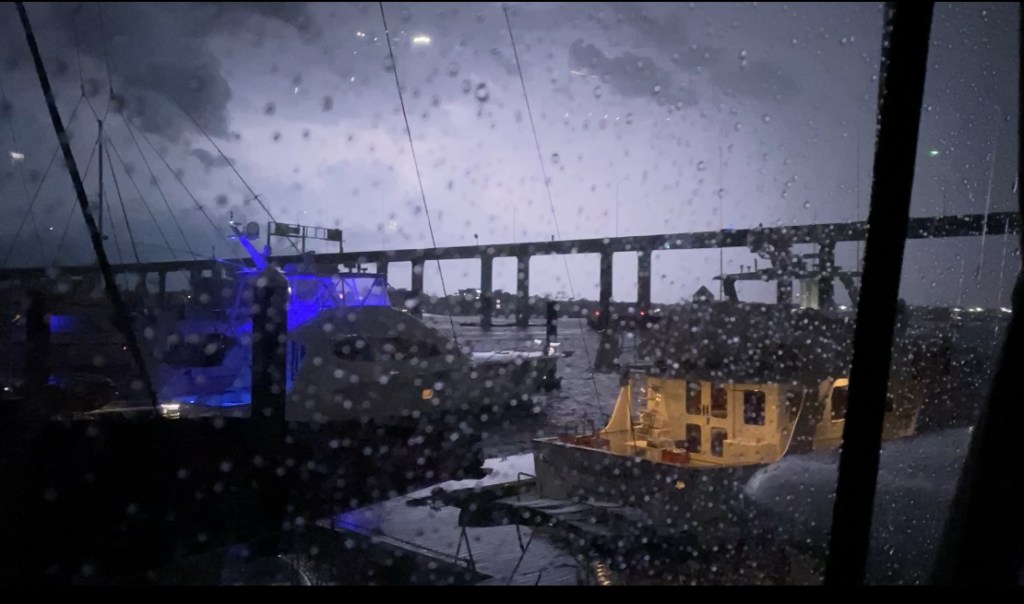
We’re happily docked tonight at Charleston City Marina. The weather that began with this morning’s drizzle became sunnier and fresher all day long, until an hour ago when the storm reached us from the west to light up the Ashley River, James Island Connector, and the boats docked behind us.

We watched it roll in as we ate dinner well after 2000. Though we didn’t exactly plan it this way, today IH covered 85 miles of winding creeks, past scores of no-wake zones, and in company with hundreds of biting flies.

When we cruised past Parris Island, I wondered how any recruit could stand at attention while being gnawed by those flies. Ditto their drill instructors!

Katie doesn’t care for them either, though I think the reason she made a nest and gathered her stuff together had more to do with the rough passage across Coosaw Sound. She’s still nervous when we rock and roll, though as we came through Elliot Cut into Charleston, she and I sat on the bow; she looked happier than she’d been all day, so maybe she just wants to get up front and see what’s coming before the rest of us.

After dinner, Pete and I talked about tomorrow’s plans as the thunder and lightning moved closer. But I think we’ll just wait and see what things look like in the morning before jumping in. Plans are always changing.


5/8/2025 Symmetry

Today I went to a lot of trouble to get home from the marina in Hilton Head where Irish Hurricane is docked. To pick up a few things, clean out the refrigerator, and see the cardiologist. As I went about my day, I wondered about the meaning of “home”.

*
The doctor said, “You’re fine,” though noted my blood pressure was higher than it should be despite the medicine he’s prescribed.

I said I drove from Hilton Head in a rental car for two hours at 80 mph to make the appointment in time. “Maybe it’s stress,” I offered.

“Where’s your home?” he said. I pointed to my phone photo, of IH lying serenely at anchor. “Yes, but where’s your home?”

I said our stuff is in our house in town but we’re not there that much.

“So, you live on the boat?”

“Yes.”

“And do you have a blood pressure cuff on your boat?”

I said no, it’s at home. 

“You mean on your boat?” 

I shook my head. He looked at the photo, raised an eyebrow, and said it looked like we had room carry it along.

*
At the house, I found the cuff and put it in with other Important Items we’d forgotten. A shirt, some files, a tube of Voltran arthritis relief gel, face wash, and the Nutri Bullet, which we use as a food processor when we’re home on the boat, to make pesto and hummus.

*
Home might be where you know the back roads, like the ones I took home when I left home this afternoon. Google showed I-95 as a long orange and red stripe between Savannah and the Hilton Head exit. Back roads seemed a good idea.

I missed a turn, though, because it’s now an off-ramp instead of a stoplight. I ended up in Port Wentworth where they’ve replaced acres and acres of wetland with massive container yards. I got straightened out when I recognized U.S. Sugar, which has been there forever.

I turned into the Low Country, drove through Bluffton, and on into Hilton Head on roads I know, though there’s a lot more traffic than I remember.

*
When I got home, Pete and Katie were there to help unload stuff I’d cleaned out of the refrigerator back home. The thunderstorms that had caused the accidents which turned I-95 red had moved offshore.

The inky dark clouds made the sun seem brighter and fresher. Lightning still zigged and zagged across the sky, but far away, out at sea.

*
I said hello to the man in the sailboat opposite, which is an oceangoing catamaran named Hokey Pokey, homeported in London. I asked if he’d sailed from there. He laughed. No, he’d been in the Bahamas all winter and is now heading north to the Chesapeake where she’ll be put on the hard until next winter drives him away from home, in England, and back to the islands.

*
It’s complex, this notion of home. Complex to come and go, like I did today. Like Hokey Pokey does. Like we all do.

I’m glad to be home. As I chilled on the bridge, another sailboat’s lovely symmetry caught my eye. The tall mast, the standing wire rigging, the stays — the things which anchor the mast to the hull like branches to roots. Like wanderer to home.

Without the rigging, the stuff in between, the boat would lose stability. It couldn’t withstand the forces the wind brings to bear under sail.  Which might serve as a comment about home, which is not a place but rather the living we do in between homes, the stabilizing things which allow us to withstand the world’s pressures, no matter how mundane.

The symmetry we can find in our lives despite traffic jams at 80 miles an hour. Dirty refrigerators. Ubers and rental cars and thunderstorms.