5/29/2025 Standing Into

We left Bluewater Safe Harbor Hampton today after three rainy, windy days at the dock.

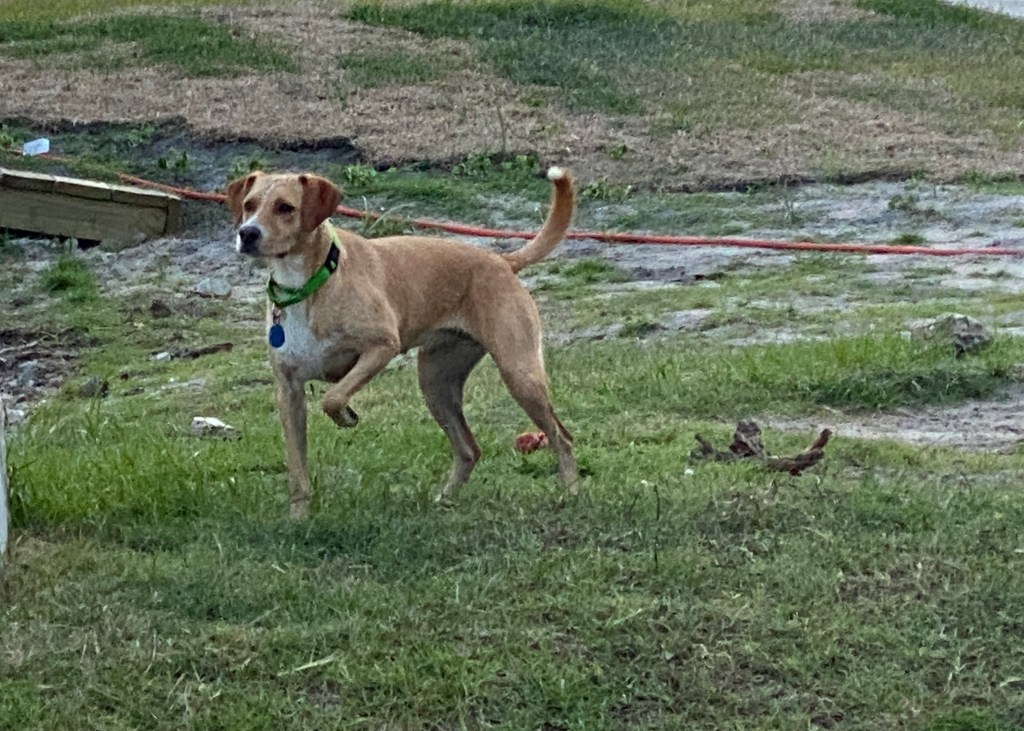
While we were there, Katie loved the long bike ride all three of us made along Chesapeake Avenue between rain showers. She loved being off-leash around the marina, until she discovered rabbits and I had to crawl through condo shrubs where she’ dropped her last ball in pursuit of livelier prey. After that, I was more judicious with tethering her where temptation existed.

She reined herself in enough to have a swim at a nearby boat ramp plus a few go-fetch outings at a huge, vacant, lush and grassy lot the marina manager also managed. After Katie won him over at the marina office, he generously gave us carte blanche to use it.

*

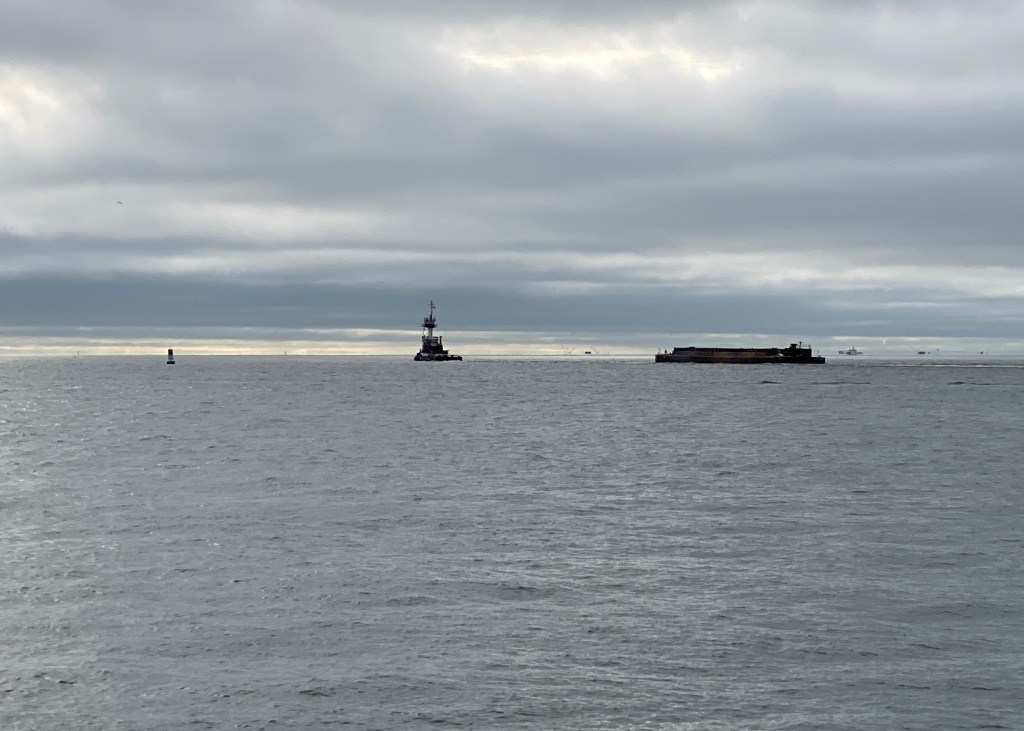
This morning we stood into the Chesapeake Bay. Tons of interesting traffic transits between Point Comfort and Fort Wool, a mile-wide passage over the Hampton Bridge Tunnel and under the I-64 Bridge: Navy and container ships, tug-and-barge combinations, sport fishers, cruisers, power boats, sail boats, fishing boats.

Inbound vessels headed for the Naval Station, port terminals, and marinas are maybe glad to be in sheltered waters. Outbound vessels stand into the Bay to turn north toward Annapolis and Baltimore or east toward the Atlantic.

The Chesapeake is the largest estuary in the US and formed by the drowned valley of the Susquehanna River. The Susquehanna is one of the world’s oldest continuous rivers, about 450 million years old and going strong.

Seas picked up a little as we turned north. Virginia’s Eastern Shore was too distant to see.

*

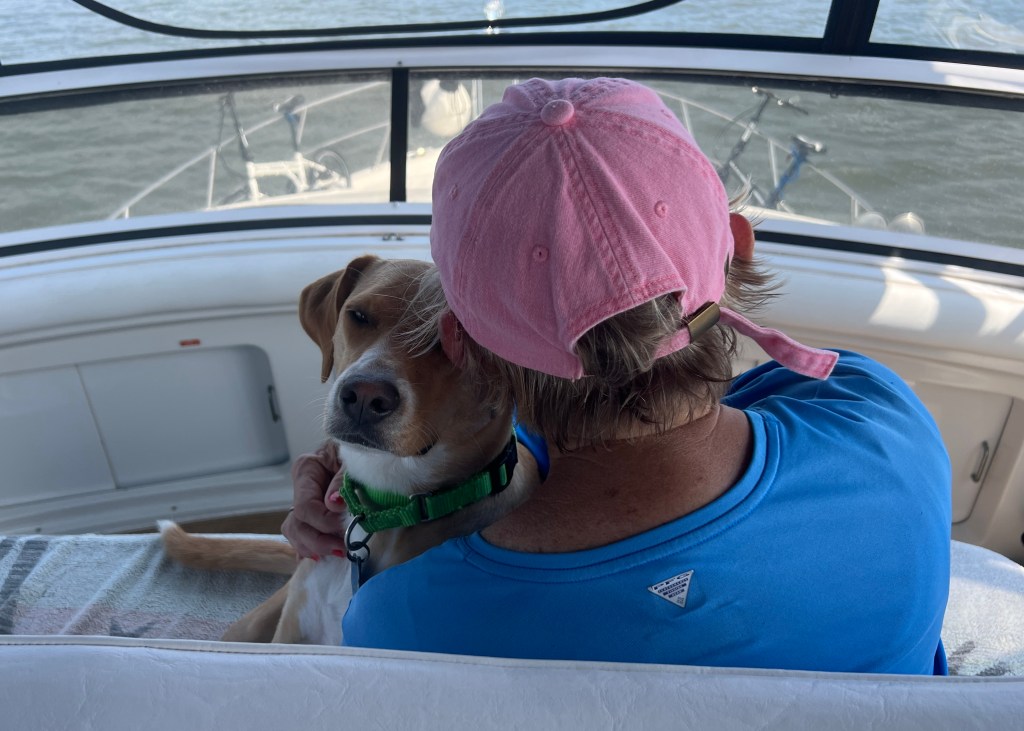
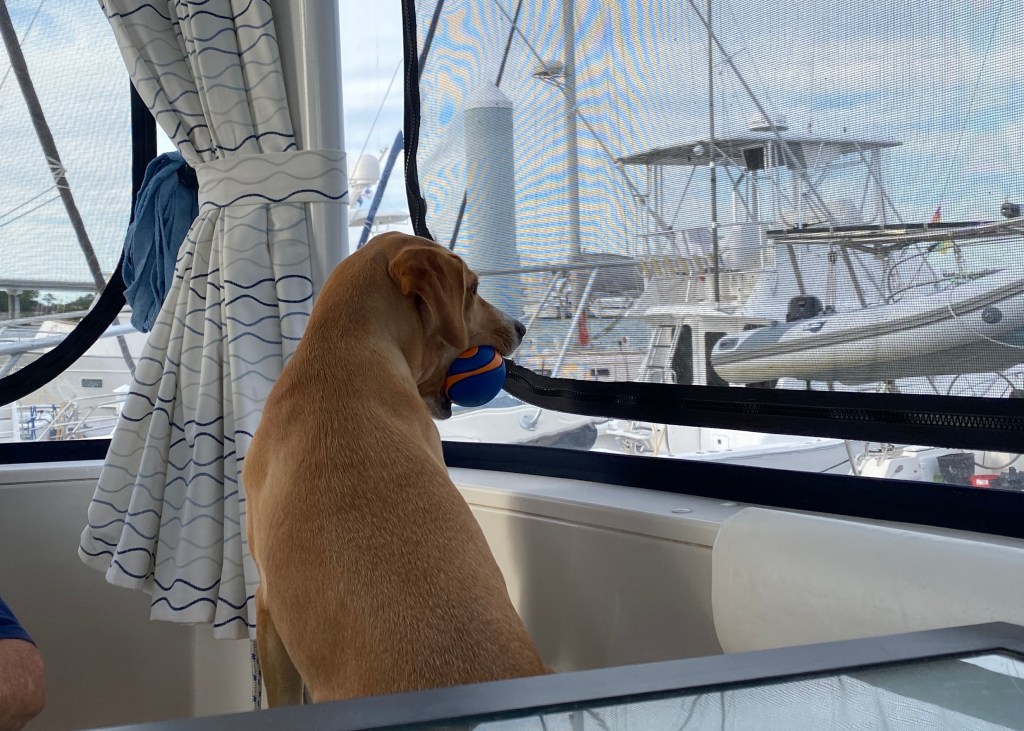
Pete and I stood watch two (hours) on, two-off. The sun peeked out then ducked under again. Katie snoozed on the bench. The day was uneventful. As I drove I considered the term standing into.

Stand implies a fixed or stopped position. As in when the tide stands at slack water, those few moments or minutes when water has stopped horizontal movement. The Bay is 200 miles long – long enough tides rise and fall vertically at different times and rates at different locations; its tides and tidal currents are a factor in vessel speed over ground.

The idea is to time travel to catch a swift current heading with – or at least not working against us. We’d prefer to reach difficult channels or docks at slack tide. Like most human affairs, it feels better to ride the tide than to buck it, and take a stand without being pushed around. In a boat, this makes sense. In human affairs, not always.

*

Standing into has a different meaning: a continuous posture (standing) moving toward something (into). More is happening. Hopefully you know your destination. Or, for example, if you are standing into danger or difficulties, you recognize the situation before it is too late.

*

The radar is still down. Repairs are on hold until a twenty-dollar antenna-turning belt arrives. Fortunately we have had clear weather and always use AIS as do many local vessels (and all commercial vessels).

The wind was low today so the few sailboats we encountered were motoring in a straight line, which always makes life easier for us. As always, we were in loose company with other northbound cruisers.

*

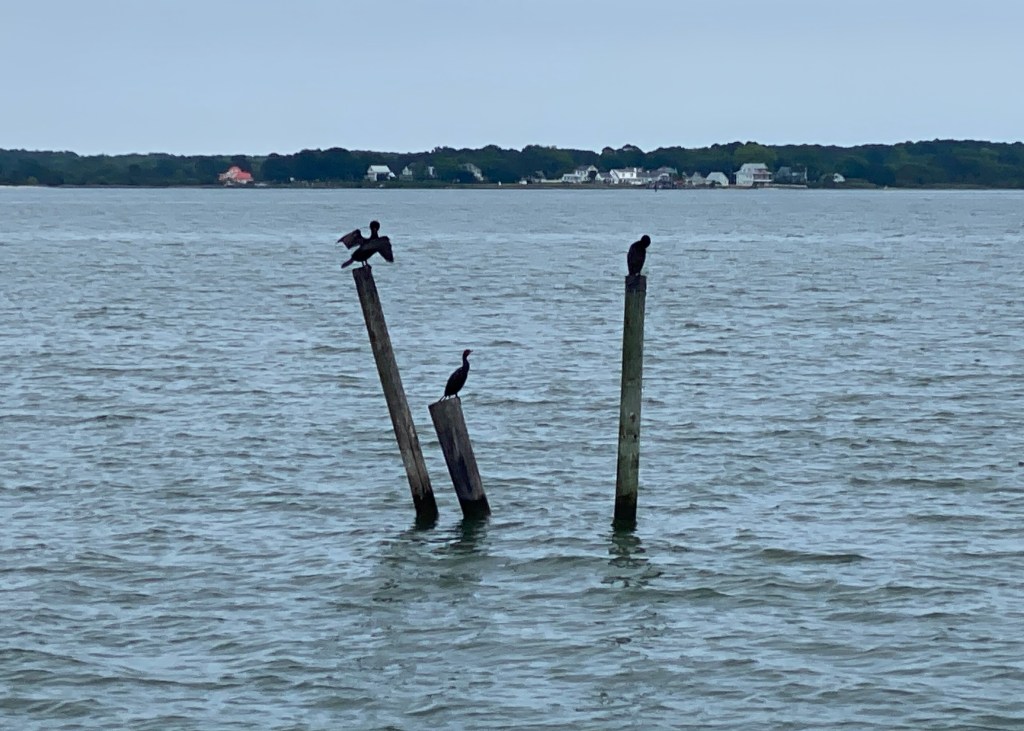
By 1600 IH was standing into Ingram Bay. The channel was well marked, if shallow. Chesapeake fisheries are legend: shellfish — crab, and oysters — but also menhaden and striped bass. We approached the marked channel dodging pot floats and fish traps.

The marina had the ambiance of a small operation that hadn’t changed much in decades. I easily imagined a snapshot from the 1960s would not show much difference. A brick fireplace had logs in a teepee ready to light. Six or eight kayaks were neatly stacked on a livery trailer. Most of the docked vessels were sailboats.

*

Katie stayed out of the water after I noticed child-fist-sized stinging jellies drifting around. But the rural marina was surrounded by huge, mowed, fallow fields. They reminded me of Ohio (except for the adjacent Bay).

She ran to her heart’s delight until one of those amazing new creatures – a bunny — caught her eye. I estimate she ran a quarter mile before she turned back. She was gone less than three minutes but still earned leash time-out until dinner. She did a better job of sticking close later in the evening.

*

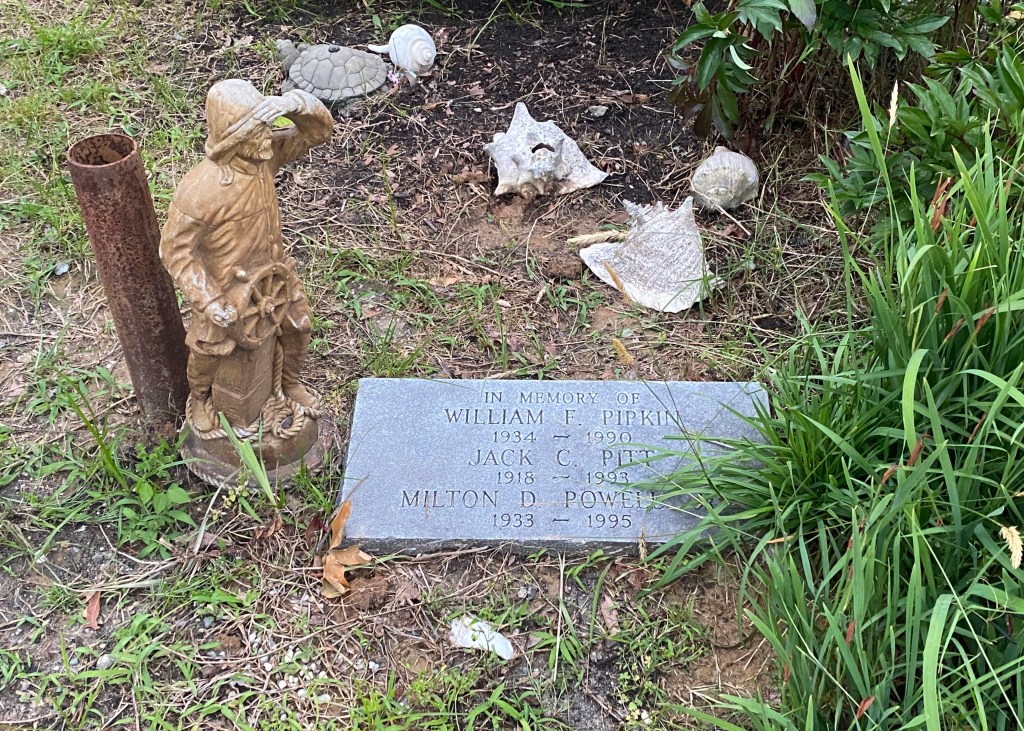
While Katie and I walked around, I spied a fake road sign. It showed a lanky, stooping fisherman in silhouette, wearing a hat and carrying a rod. It said CAUTION: OLD FISHERMAN. A few minutes later I saw a marker and dockside shrine to men I imagine haunted the dock and still haunt the dock at Ingram Bay Marina.

I have already lived more years that William or Milton. I hope to outlive Jack. I’d rather not be standing into the afterlife any time soon.

Tomorrow we have a 100-mile day but plan to reach our new home port at Kent Island. Fingers crossed.

5/26/2026 Memorial Day

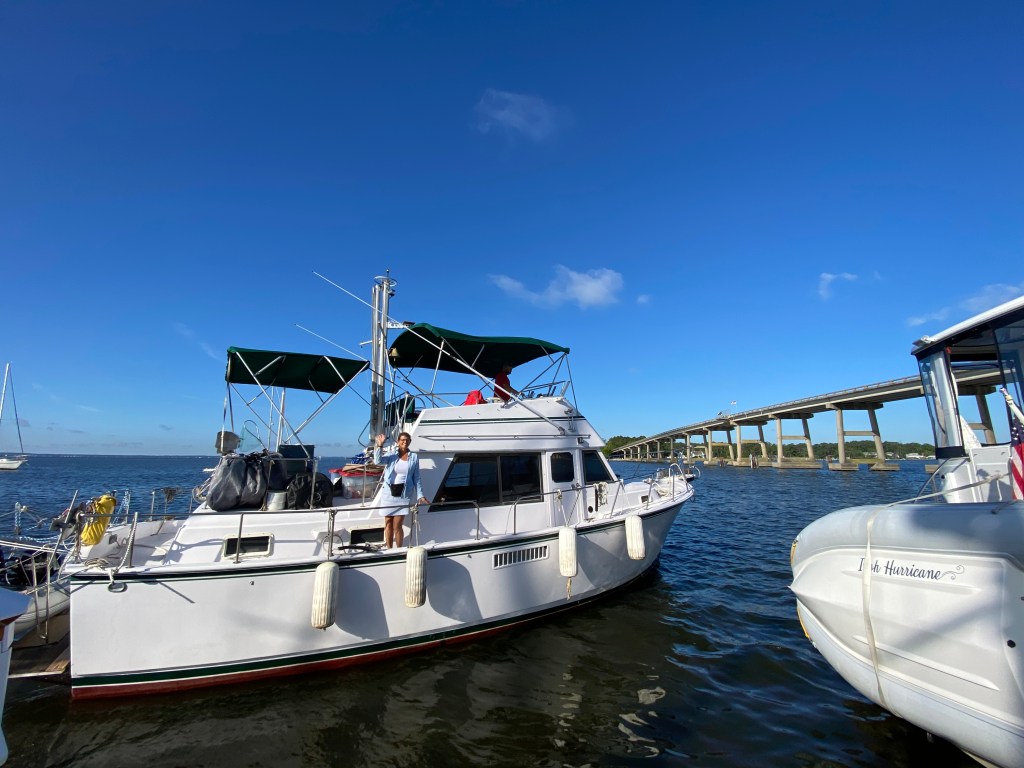
It seemed fitting that today, Memorial Day, Irish Hurricane followed the 72-foot classic yacht Independence from Coinjock through Norfolk, home of the largest naval base in the world. As she did yesterday, IH was one of many in a line of boats joined in purpose – going north.

All of us stayed more or less in the same order that we departed Coinjock. Every time our flotilla reached a barrier, the boats went into a holding pattern – at a drawbridge, a swing bridge, a lock, and two railroad lift bridges. Finally we spread out and went our separate ways as the Elizabeth River widened into Hampton Roads and the Chesapeake Bay lay ahead.

*

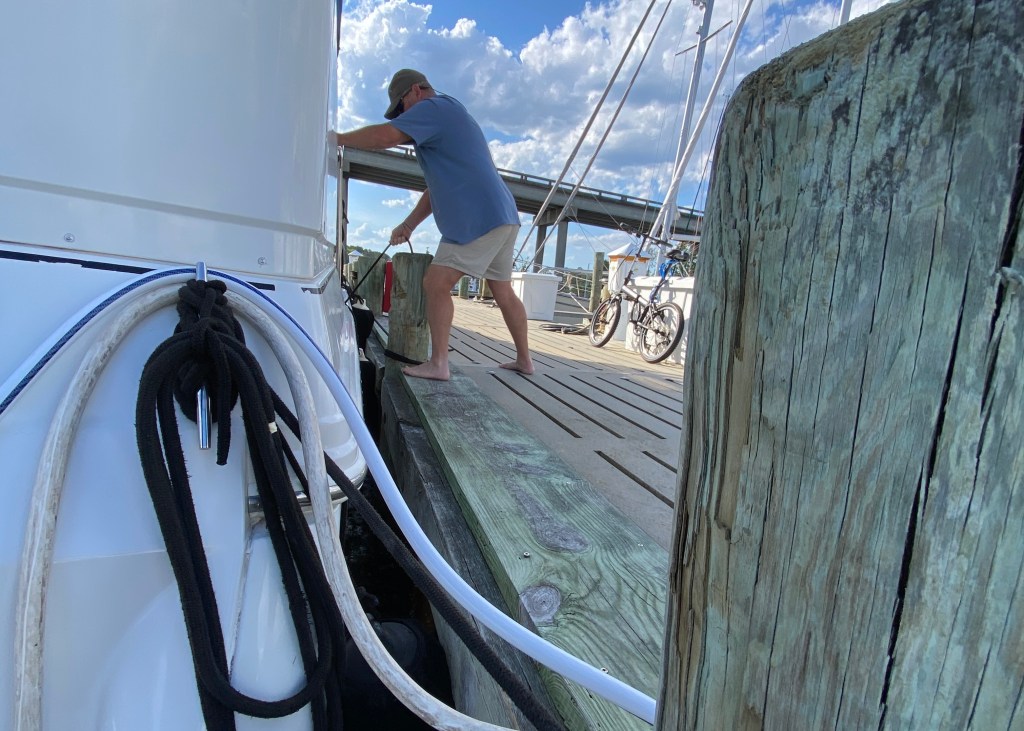
There was a delay at the lock when a single-screw trawler had trouble maneuvering to the wall. Pete jumped ashore – IH was already tied up with engines secured – and jogged barefoot to help the lockmaster bring the trawler alongside. Katie was jealous he got to go ashore. I felt proud to have a husband who sees and responds to another person’s need for assistance.

It seems like a small thing. Offering a hand to a fellow traveler. It’s not. In this way, on a global scale, the world becomes its best self. It is this attitude that has kept liberal democracy alive.

Freedom isn’t free, as we all learned in elementary school. Or should have. The price of freedom is eternal vigilance, which was a popular 19th century aphorism and thus may have been spoken by Thomas Jefferson. However, the actual quote is attributed to the Irish orator John Philpot Curran; I take it the context was Irish independence from Britain.

*

Norfolk was less busy than usual today. I finally realized everyone was off for the federal holiday. The shipyards were quiet. The waterway was absent most of the tug/ barge/ ferry/ security boat traffic we’ve seen before. We passed an aircraft carrier in drydock. I imagined jets taking off and landing under fire in a war zone.

I imagined the number of sailors – and marines, airmen, soldiers, and yes Coast Guardsmen – who never came home from action.

*

We docked around 1630. I am glad IH is moored safely. Glad we have reached the end of the Atlantic Intracoastal and are standing into the Lower Chesapeake. It is Memorial Day – the unofficial start of summer. The day the pools open. But it’s more.

I am glad to have had the opportunities I have growing up and now growing old in America. I recognize those opportunities cost millions of Americans their lives. On Memorial Day I feel deep gratitude for the women and men, drawn from any group you can name, who gave their lives for our country. Who gave their life for me.

5/25/2025 Windrows

Up at dawn for the 88-mile run from Belhaven to Coinjock, NC. Belhaven is a small stopover village. Coinjock is a long dock, a restaurant, and performance art as each successive cruiser docks.

We were in a line of northbound cruisers all day. Not exactly snowbirds. Migrating snow-whales? Snow-jellies drifting with the sun?

I called Sound Waves to arrange passage; they came back on 68, “Good morning, Irish Hurricane. How’s Katie today?” She was passed out on the bridge bench after a long day before. I waved them thanks for her new ball.

*

Coinjock is the only ICW stop between Belhaven and Norfolk via the Albemarle & Chesapeake Canal. It’s crowded. Every boat is docked to accommodate those that follow. “Nuts to butts,” as they say in boot camp.

Our anchor loomed over Endless Summer’s stern. The polished chrome anchor of the sleek yacht behind us loomed over IH’s dingy. The docks were a symphony of dockhands, captains, wind, water, and crews handling lines as evening approached.

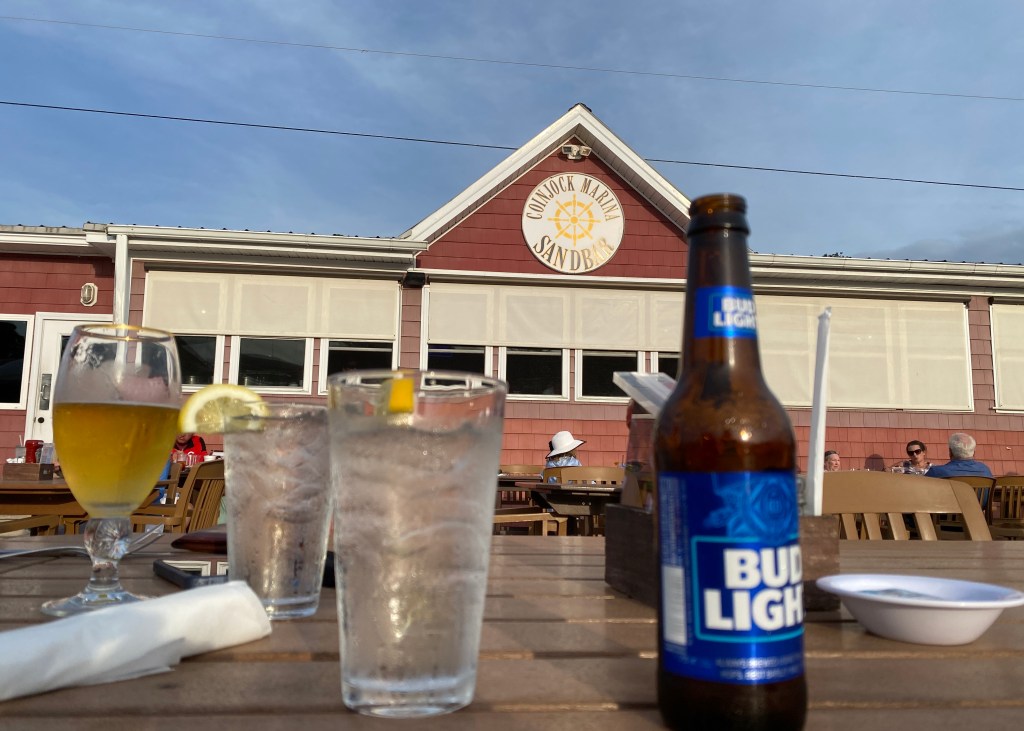
Katie and I hopped ashore. The dock buzzed with captains, crews, boats, and spectators at Coinjock’s iconic restaurant. It’s a local favorite, the only place for boaters to get a meal, and affords elbow-rubbing for everyone. Pete and I headed up for dinner once IH was secured.

*

A flutter of teenage girls arrived for someone’s birthday. The young women wore summer dresses I also might try if I were 17. “They’re wearing the same thing,” Pete said, which was not true. Variations on a theme of sleeveless, short, pretty pastels. The birthday girl’s parents chaperoned. The old man sat at the head of the table beaming but misty-eyed.

*

A swagged rope separates the dock and spectator promenade. Boat owners and operators walk one side admiring, querying, and chatting. Pete learned the sailboat we passed had been forced fifty miles offshore on Friday, when the Cape Fear River entrance stymied them with roiling current and wind.

Voyages are discussed. Boat cards exchanged. An unwritten departure order is generated as cruisers get a fix on each other’s experience, vessel maneuverability, cruising speed, and morning departure time. As with other human affairs, you know what you know pretty quickly.

*

Everyone seemed wind-burned. The day had produced less wind than predicted but enough to take note. While at the helm, I remembered Christina Rosseti’s lines:

Who has seen the wind? Neither I nor you.
But when the leaves hang trembling, the wind is passing through.
Who has seen the wind? Neither you nor I.
But when the trees bow down their heads, the wind is passing by.


It is a marvel that unseen things can exert such large effects. Force a boat offshore, fill sails and move it along. Wind, like a compass, is a low-tech phenomenon with huge implications.

Wind and water are fluids. They flow – over and around barriers, or unimpeded. They appear as negative space. E.g., a wind shadow appears downwind of a land or trees in a lee. Only the wind’s effect is visible.

Cat’s paws appear where wind riffles a patch of water as the wind picks up. As wind speed increases, friction does, too. Waves grow bigger to add resistance to the wind. High winds create stormy seas.

By the time we exited the Alligator-Pungo River Canal, the wind was gusting and had a long fetch spinning up windrows.

Windrows begin with Stokes Drift – downwind surface current. Stokes Drift leads to Langmuir Circulation under the water surface – vertical counter-rotating vortices. Langmuir cells cause upwelling: bubbles, flotsam, and nutrients collect where upwelling cells converge. The resulting lines of drift run parallel to the wind in long lines called windrows.

Even a small wind has an effect. A large wind can churn things below the surface which, as it turns out, is healthy for the water body. Redistributed nutrients and whatnot.

*

The wind died considerably as IH approached the Alligator Swing Bridge yesterday. Its laconic tender radioed on 13, “Ah-rush Huacann, what’s yo Coas’ Gahd Numbah.”

I passed him our document number as I kept station into the wind, parallel with the windrows.

*

The last boat to dock at Coinjock was the 72-foot Independence. She was afforded about 80 feet of space directly in front of the crowded restaurant patio. She is a beautiful Burger Yacht built in 1968. She pulled gracefully into her moorings near sunset, so close to the (also beautiful) yachts fore and aft that she drew applause from onlookers when her lines were over.

It was a beautiful thing to see. An exquisitely designed and built, classic and sturdy vessel driven by an obviously competent captain to a perfect landing. It gave me chills. Judging from the crowd’s reaction, I imagine I wasn’t alone.

.

5/24/2025 Compass

Tonight, will be a short post after a busy day. Irish Hurricane came 48 miles this afternoon, from Oriental to Belhaven, North Carolina. All of us were up early to get a jump start on the miles. 

*

Pete and Katie took a good run before we got underway. That is, Pete rode his bike. Katie ran. Meanwhile, I set up the bridge – iPads, VHF check, chart plotter, and Bad Elf. There are switches to turn off and on at the main panel to power the bridge.

Other switches secure shore power and water and need to be toggled before we unhook either one to switch to 12V battery power and water from the boat’s tank. Ship’s power goes off on the 120 panels (one for a/c, one for appliances and lights). The pressure pump goes on to force water to faucets and heads from the tank.

We filter our drinking water twice: once through the inline filter at the hose and a second time through a Brita pitcher. One pre-underway task is filling the Nalgene bottles that in turn supply the Brita pitcher in the galley. Another task is to ensure the water bottles and other loose gear are stowed for sea.

Last week Pete found an unstowed cantaloupe, forgotten on the counter, in the aft cabin. Presumably it had tumbled like a happy basketball from the console next to the Nalgene bottles then through the salon and down four steps before coming to rest under the vanity.

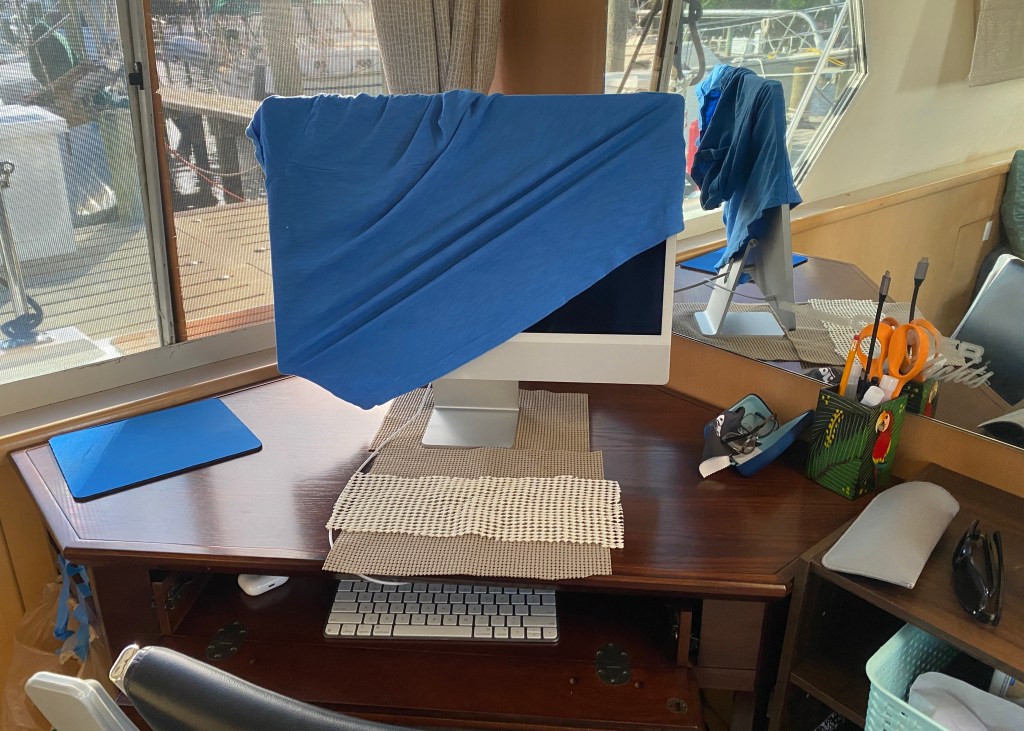
A last thing to do is make a quick round to make sure gear is secured. Two particularly important objects need extra TLC: the countertop TV and my desktop computer. The TV clips to a nearby bulkhead. My computer wears a tee shirt to protect glass before I lay it face down on grip shelf liner.

*

By the time Pete and Katie returned from their run, IH was ready go to. We lingered on the dock chatting with the Michiganders forward of us and the North Carolinians aft. Everyone had a plan. One boat was heading south, one north, one nowhere at all. We all have internal compasses against which we plan. They all point north, though we follow different courses.

*

Docking at the end of the day is like running a movie in reverse: water hose over, shore power on, switches reswitched and unswitched. A ride for Katie. We chat with other boats along the dock and near the kayak launch Katie claimed as her stick-chasing venue. She’s turning into a powerful swimmer.

One family is working hard to expose their teen-age son to the world he will shortly inherit. Another couple, longtime lake boaters, are uncertain about saltwater and its complications: coastal winds, tides, and currents to name three.

Katie made friends all around. Somehow, she convinced the teen-ager to replace her old, torn, and worn ball with a brand-new one. As with this morning, everyone discussed plans. One boat is heading east, one north, one south.

*

My watch today included a large turn – close to 270 degrees – over several miles. We set out going southeast then came left, and left, and left. until we were heading west. I watched the numbers spin around the compass as we turned, marveling at the instrument’s simple concept.

The beauty of a compass is it stays true to North. When you change course, you can look at the compass and believe you have not turned at all. It might appear for a few seconds that the compass that has moved, not the boat. This is only an illusion.

A properly calibrated compass always points to magnetic north (a gyro stabilized one, to true north). It does not lie. It is reliable under all circumstances. You may believe the vessel you are on has not changed course, that the compass is the unreliable thing. But that, as I said, is only an illusion.

The trick is to trust the compass: to not be fooled into believing the truth is a lie. To disbelieve the notion the ship itself has not changed course. It’s easy to get lost without a compass.

But I digress. We had a satisfying if long day. Tomorrow promises to be another as we follow the compass north.

5/23/2025 Running in Circles

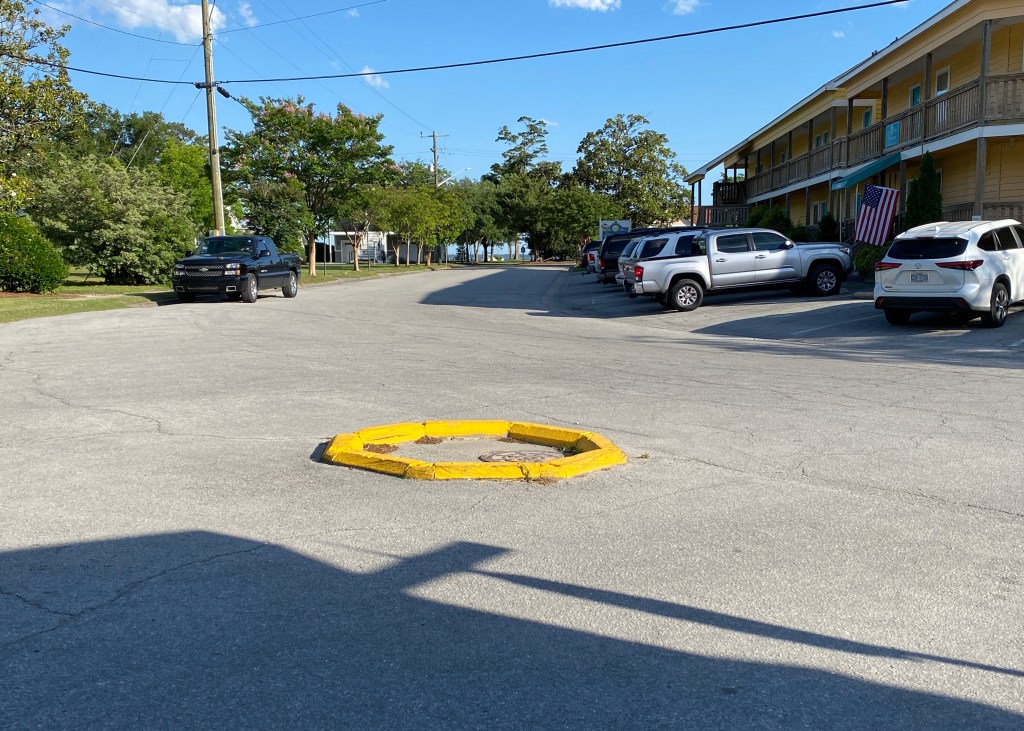
Sometimes life feels like a traffic circle: a roundabout where you’re stuck on the inside lane. I’m not sure that analogy holds up with Oriental’s tiny yellow traffic circle, but you get the idea.

It has been that kind of twenty-four hours. I think Pete and Katie felt it, too. It began with yesterday’s high winds, continued overnight, and finally spit me out an hour ago where I landed with a beautiful sunset.

Yesterday afternoon, a sailor tapped on Irish Hurricane’s hull to say maybe we didn’t know, but the wind was coming around to the west and would cause the water to rise. He called it a tide. I took this to mean in the Great Lakes sense of the word, where high winds can stack water up along the lee shore and it seems like the tide has come in.

He pointed to our hull, already being pushed hard along the dock, higher than when we’d moored and thus no longer protected by fenders. Pete thanked him, by which time I was on deck. We proceeded to order each other around, telling the other one how to best push the boat off far enough to free, then raise, the fenders.

The wind and the noise that it and the water make can drive you crazy. Certainly grumpy. “Remember that time we sat for a week at anchor in Key Largo?” I asked Pete, knowing neither of us will soon forget the wind, noise, and rain as we waited for a storm to pass.

As if one bad memory weren’t enough, I added, “And that time in Bahia Honda?”

”Uh-huh,” he growled.

Things seemed to settle down by the time we went to bed. I haven’t slept well for a week or more and looked forward to a full night of sleep. My habit is to read myself to sleep only to startle awake after midnight. It’s hard to get back to dreamland.

I’ve explained this to Pete. Yet, when his phone weather alert went off at oh-dark-something, he thought it was a good idea to wake me up to share the message.

”It’s going to rain,” he said in the dark. I glared at him and pulled the covers over my head. He went topside to close isinglass though it had already rained in. I am not proud I didn’t get up to help him, though I was not clear he was asking to be helped.

About the same time, the wind picked up again. A lot. Water slammed around under the swim platform, which is just aft of the aft cabin’s bed. Katie was scared. She woke up Pete. Pete folded out her fake-sofa mattress twin bed and tried to sleep with her. But as soon as he was settled in on the salon floor, she left to join me.

The rest of the night, she edged me out. I had less than a foot of mattress under me by the time she jumped down at 0700, fully refreshed, I am sure. Pete had been up for a while when I headed toward the K-Cup. Everyone was grumpy.

It’s hard to hide your mood on a boat. I think about my brother and me in the back seat of a long car trip. “Mom! He’s looking at me!” “Mom! He touched me!”

Pete took Katie for a long bike ride. Later, he helped the dockmaster handle lines and talked to friendlier people on the dock. I poured fatigue into my computer keyboard, though I came up for air long enough to make a grocery list for Pete and, later, to turn the groceries into eggplant lasagna.

Fortunately, this too shall pass, as they say. Now I am alone on the bridge watching a clear, beautiful night sky unfurl. The water is calm. A power boat is drifting while the operator casts for bait. The winds have dropped to almost nothing. Fingers crossed for a quiet night.

It appears another front is edging its way toward the seaboard, though, so we’ll skip tomorrow’s side excursions to Vandermere and Washington, and head straight to Bellhaven.

5/22/2025 Oriental

“There’s four thousand sailboats in this town and eight hundred people,” the woman tugging on a fishing rod told me. She was wrestling a cownose ray she’d hooked along South Avenue near Lou-Mac Park. The ray finally worked himself free. She retrieved her line and chatted with Pete and me while Katie played with her two cute dogs in the gathering dusk.

The Town website says three thousand sailboats, and the 2020 Census lists 880 people, but who’s counting? Oriental claims to be the “Sailing Capital of North Carolina.” There are so few power boats and so many sailors in our marina that I believe it.

There were three power boats along our face dock last night. This morning, the other two continued north. There are more around, though power boats are a minority in this small town.

Sailing must be fine here. Oriental sits close to where the Neuse River empties into Palmico Sound, the smaller of North Carolina’s two major water bodies between the Outer Banks and the Inner Coastal Plain.

The town is named after the Steamship Oriental, which wrecked off the Outer Banks in 1862 while carrying Union troops to South Carolina. The ship, which also carried sails, was less than two years old. The town didn’t yet exist.

Nobody is sure how the US Post Office at Smith Creek picked up the name Oriental. The postmaster’s wife was involved. As was the official nameplate of the ill-fated sugar cane carrier that had been pressed into troopship service. The name stuck. It’s a beckoning name. The town’s New Year’s Eve Dragon Parade is an add-on that has nothing to do with the steamship.

It’s a lovely small town near the waterfront, which is what we’ve seen. Big, lush, green lawns and sturdy, well-kept. sometimes quirky homes. A Provisioning Company sells everything from food to dinghies. There are plenty of shrimp boats and a doll-house-sized seafood market.

An old painted school bus might have been at Woodstock or once used to carry the Cowsills to concerts.

Lou-Mac Park was filling up as we walked back from John Bond Town Beach this afternoon. Townspeople were gathering, chatting, and taking sunset-view seats on bright resin Adirondack chairs. Some arrived by golf cart, which seems to be a popular way to get around. Three or four teens had pulled up in a pickup truck and were sitting on the hood. Two more lounged along the fishing pier rails, vaping.

A hand=painted sign announces Sunday services at the park at 0830 Sunday. We saw a similar notice at the sponsoring congregation, the Oriental United Methodist Church. We’d taken Katie there to run in a big mowed lawn adjacent to the church where a sign said, “Parking Lot. Welcome.” We took that to also mean Katie and her ball.

For most of the day, a stiff gusting-to-25 beam wind slammed IH against the dock. I quickly remembered the tedium of randomly timed waves gunshotting under the swim platform. Katie is not a fan of the boat tugging at its moorings while their report reverberate through the hull.

Which is why we’d gone off to John Bond Beach to begin with, past the Methodist Church Parking Lot and Lou-Mac Park. The beach measured 75 x 100 feet on Google Maps. Enough for Katie to chase pine cones. She threw them into the water by herself, which earned her a swim platform shower before dinner.

She’s asleep on the bridge now; she seems to like sleeping under the stars. I imagine she’s dreaming of pine cones, or maybe the ray: the one that got away.

5/21/2025 Wandering

Last night we had a quiet dinner in Beaufort’s very loud Mazcalito Restaurant. Pete and I are too engine-noise deaf to wander into so much noise and still expect to converse. The company was still good, as was a fat plate of shrimp-and-pork-nugget supreme nachos we four shared, and frosty 22-ounce mugs of Dos Equis XX beers for the men.

*

Katie got her morning walk down Ann Street today. We stopped at a smaller yet spacious park where she fetched a few balls. Pete pointed out Beaufort’s unique up-and-down picket fence style, which has something to do with the town’s archaic hog ownership laws. I couldn’t figure out how the two relate.

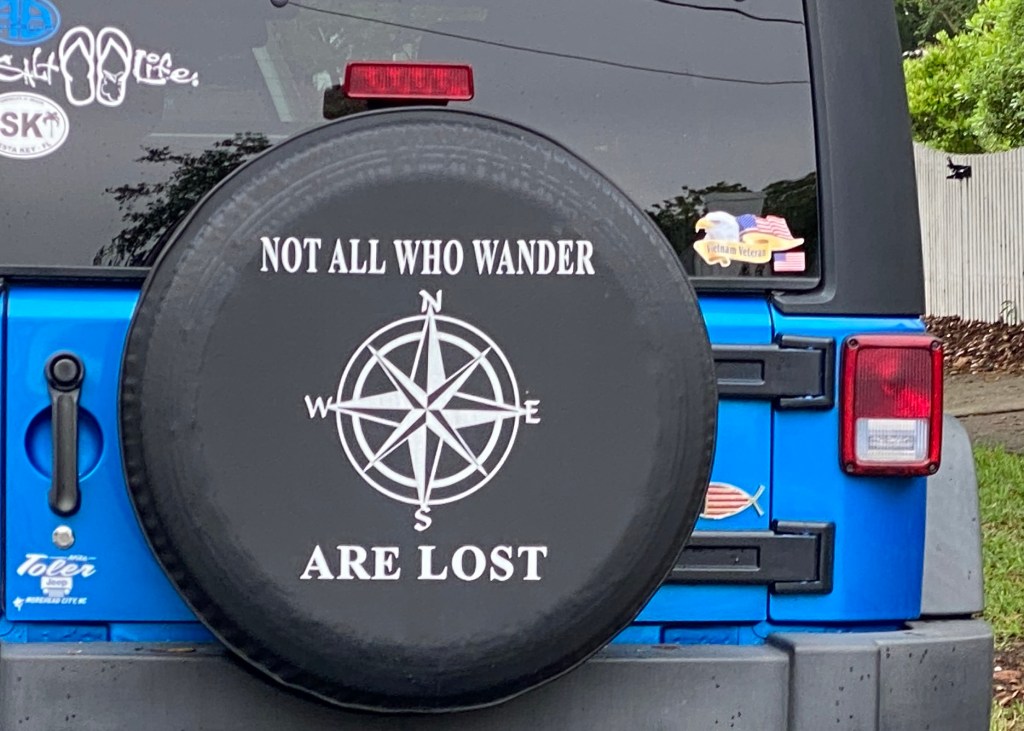
On return to the boat, I spotted a sporty blue vehicle with a spare-tire cover opining, Not All Who Wander Are Lost. Which caused my mind to wander. And wonder.

*

Wander: to move in a leisurely, casual, or aimless way
Wonder: to desire or be curious to know something

(I Wonder As I Wander is John Jacob Niles’ 1933 adaptation of an Appalachian folk hymn. Niles first heard the hymn in Murphy, North Carolina, sung by the daughter of a Revivalist family that was trying to make ends meet during the Depression.)

*

Life aboard Irish Hurricane is rarely leisurely: lines, shore ties, miles of walking and hours to accomplish what we’d otherwise achieve in a car or by Amazon.

Casual doesn’t seem appropriate. Nor is aimless a good description of our travels; it does not seem to apply because in fact we wonder as we go. Wondering is curiosity’s first step, the thing that leads you to question and think. Thinking is work. It is not aimless.

I agree with the sentiment, though. Not all who wander are lost. Though, not all who wander are not lost, either.

The quote comes from J.R.R. Tolkien’s poem about Aragorn aka Strider, the Ranger of the North. He joins forces with Frodo, Gandalf, and the Fellowship to defeat Sauron, who would destroy the world for his own power-hungry ends.

All that is gold does not glitter. Not all those who wander are lost.

The Internet tells me the poem’s deeper meaning is this: a journey should have a purpose.

Mine is to cultivate empathy. To learn the ways that other people in foreign cultures (domestic or not) are solving the problems of living. To see that most of us are doing the best we can with what we have.

To see that I might behave the same way under similar circumstances.

*

By the time I realized this morning that we were a mile past Hammock House, it was too late to double back for a photo — we had a date with the fuel dock for sewage pump-out, and wanted to leave Beaufort in time to reach Oriental before winds kicked up the Neuse River.

Google Hammock House. It is a West Indies-style two-story that is claims to be the oldest standing house in Beaufort and maybe North Carolina. Early maps call it “the white house”.

Blackbeard purportedly headquartered at the White House for a while. They say he hanged a young French concubine after he forced himself on her. He was in a fit of rage. They say you can still hear her ghost screaming.

*

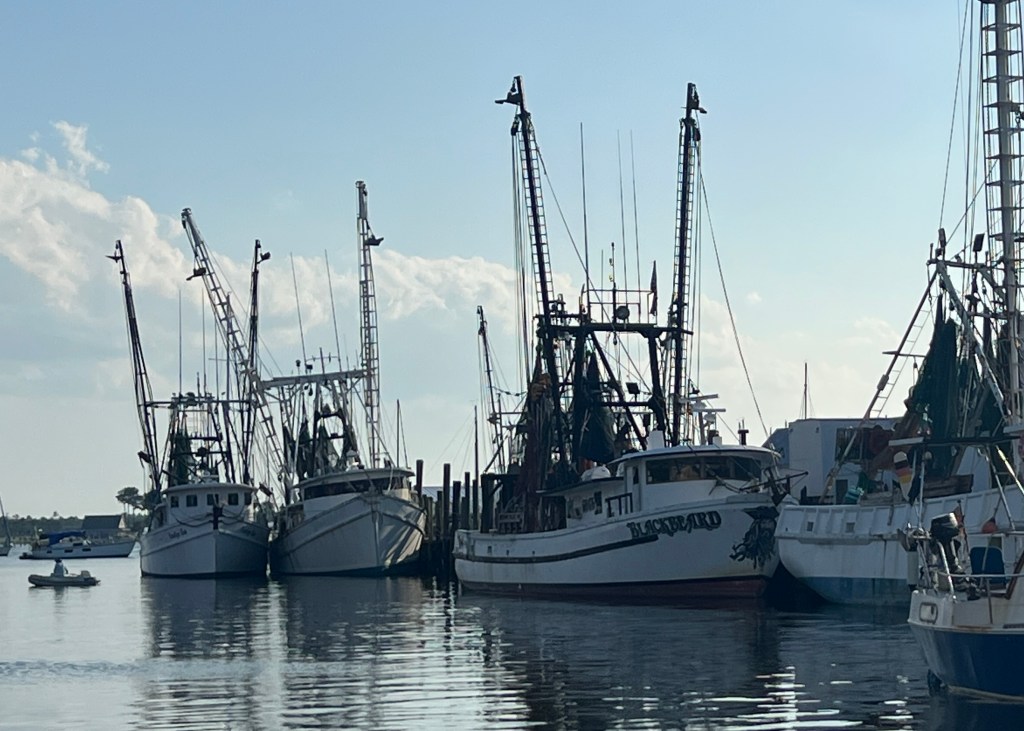
Here in Oriental, where IH is docked for the night, Pete spied a more modern Blackbeard, one of Oriental’s large shrimp fleet. Tomorrow we’ll look for fresh seafood before getting underway.

5/20/2025 Freedom Park

Katie does one thing better than anything else. She runs. Today she got a 4.5 mile round trip run from Homer Smith’s Docks to Beaufort’s Freedom Park. Pete held her leash. He and I biked. We found the trail that let us bypass the shoulder-less county road.

At the park, Katie ran and ran on the ocean of grass. A maintenance worker stopped by and warned us about sunning snakes, though we were in the shade. He’d busted Katie off-leash, and I suspect he was satisfying himself she was not a threat.

She warmed him right up. Then he said she was fine unleashed and welcome to run anywhere. Except on the baseball field. “I just lined that one,” he said, pointing three playing fields away.

The park was spotless. The many soccer, baseball, and one football field were meticulously lined. I assured him Katie wouldn’t be running on the playing fields. He bid us good day and continued his golf cart round.

I guessed he loved his job as much as Katie loves to run. He was invested in the lines he’d put down. He told us he wanted them nice for tonight’s game.

*

Katie trotted more slowly on the ride back, which gave me time to check out Beaufort’s beautiful homes. Some are more than 300 years old. Their architecture reflects immigrants that arrived, then stayed. Caribbean and Bahamian houses, Queen Anne and Victorian houses. Greek and Gothic Revivals.

The oldest dates to 1700. They say that one had been an inn Blackbeard once visited.

*

I’m an old house junkie. I think about how people arrive at a place, work hard, scrape together a life. Settlers build their homes knowing one’s porches and gables will outlast their own lives.

It takes a lot of foresight and fortitude to build for the future. To know what you construct will have a life longer than your own. To know that it will be admired after nobody is left to remember you.

Most of the houses are restored. Some have modern or quirky flourishes. One has a vine-covered entrance pergola that seemed to bloom with conch shells. A tabby cat stood guard like a small beefeater at his post.

*

A yard sign caught my eye: Sailor Jonny’s Custom Carpentry and Paint. I met a woman who knew him well. She told me Jonny was indeed a sailor, who arrived here on his boat, “oh, about ten years ago now.” He did odd jobs. He was good at what he did. He built a business. Now he’s in high demand; I surmise he helps to keep these cantankerous old houses as beautiful as they are.

Jonny ventured into the world and found a place where his work would outlast him.

All of us venture into the world uncertain about where we’ll land or what we’ll do. All of us impact a future we’ll not live to see. The choice we sometimes make is for the well-being of a future that will forget us; versus the well-being of our present selves regardless of the consequences of our actions.

Here in Beaufort, they seem to opt for sustainability.

*

Katie stood the boat watch this afternoon while Pete and I made a parts/ grocery run to Morehead City using the marina courtesy car. She’s also good at this job, though she doesn’t seem to love it as much as running.

This evening for the first time we let her walk unleashed on the docks. She held her head high as she trotted toward land. And even higher when we let her race around the flagpole at the end of the street all by herself.

5/19/2025 Wrong Turn

The day started at 0520. Katie needed to go ashore. Pete and I wanted to reach the Onslow Bridge before the 0700 opening. The anchorage was quiet when we dinghied to the Mile Hammock boat ramp, where we found friends on the same mission.

Katie ran around for a few minutes. We all caught up. Back aboard, I hauled up a very muddy anchor after Pete stowed the dinghy. We got underway with three other boats. By 0710 we were all through the bridge.

The day was windy and cooler. The waterway empty. I passed one slow-wake zone, a boat ramp where one guy was fishing. After Pete relieved the helm, I lay below to work on an essay-in-progress.

*

About four miles before we reached Beaufort and Homer Smith Marina, Pete asked me to take the helm for a few minutes. “You good?” he said, meaning, “Do you know where we are and where you’re going?”

“I’m good,” I said. IH has been through here three times. I knew where we were headed and thought he’d be back quickly. I looked around.

A big, fast boat and slower sailboat were off our starboard quarter. All of us were heading for the Carolina Coastal Railroad/ Highway 70 Bridge passage. We sorted ourselves by relative speed and the Rules and went through one at a time.

As I slid through the bridge, I turned to the chart displays. I knew the marina channel would be a starboard turn. But Beaufort is thick with buoys marking different channels and obstructions so I looked to the chart plotters for assurance.

The two ipads we navigate with run different programs. When I glanced down, I saw the courses they suggested did not match. The program we prefer to use sent me left into the ICW. The magenta line, which we trust less, sent me to the right. I agreed with the less-trusted program’s course, but balked.

Suddenly, I was in an unanticipated and not good situation. One second, I was certain of my position. The next, I saw nothing but a chaotic buoy mishmash in every direction with conflicting guidance on the charts.

The sailboat I’d preceded through the bridge was astern. A tug appeared from an industrial channel on our port quarter. Tidal current rippled over shallows all around.

*

It’s not easy for me to admit I’m lost. Not easy for any of us, I imagine. But admitting you are is the first step to getting back on track. I picked a channel — it wasn’t the correct one, but it was the one I was already in, wouldn’t confuse the sailboat or tug, and wouldn’t run us aground.

When it was possible, I slowed down to get my bearings. It didn’t take long to figure things out though by then Pete had taken back the helm. As quickly as it had turned bad, all was well. We were docked ten minutes later.

*

Shouldn’t I always know exactly where I’m at and the correct way to proceed? Should I admit I was tired, had my mind elsewhere, and relieved the helm at a bad spot? IH was in the middle of a turn, in a busy harbor, aiming for a bridge where, just beyond, lay a tugboat terminal and one channel split in two.

But it seems obvious that none of us are 100% all the time. The trick is to know when and how to admit you’re lost. Without that skill, you’ll never recover your situational awareness or begin to remedy the situation you find yourself in.

Own it, as they say. If I hadn’t owned it quickly, Pete and I might be dealing with serious consequences about now. Things not so easily reviewed and reversed.

As well, in owning our mistakes, we get to own the things we did right.

I used my head. Correctly assessed what was happening. I kept IH out of danger and did not put other vessels into danger. I didn’t react; I responded. I got help from Pete, whose experience is so much deeper than my own. What takes me ten seconds to figure out will take him a tenth of a single second.

I believe we were lucky, too. There’s always that X factor.

*

Both of us were glad to reach the dock early. We napped this afternoon before dinner and a walk along Beaufort’s historic waterfront. It’s a sleepy town on a shoulder season weeknight after hours.

Sleepy except for one of us. Katie always stands ready with her ball, hoping for a fellow traveler to see her at the back window and take her ashore for one more game of fetch before the sun goes down.

5/18/2025 The Most Important Thing

12/24/2003

”Give him the line!” Pete had yelled this to me at least five times.

I stood on deck holding the ever-important forward spring line, confused because the dockmaster I was eye to eye with was a clearly a her, not a him.

Who!?” I shouted back for the fifth time.

”HIM!” He pointed to the woman by then taking the line.

We were in storm winds and driving rain. He was driving. I was on deck. We’d been married four days. Dixie Belle was a 40-foot bareboat out of Sarasota we’d chartered for a week. 

That was 20,000 sea miles ago. What doesn’t kill you, as they say. But we still miscommunicate so often it’s our running joke. And every time it happens, I think of Chief Luce.

*

Chief Luce was my Navy Signalman “A” School instructor. We students loved him. He was an excellent signalman, patient as Job, and a square-knot sailor. He taught his charges two important things.

(1) The aim of signaling is communication. (2) Communication’s take-home point is to avoid confusion. He quizzed us on this constantly. “Why do we do this, Class?”

“To avoid confusion, Chief!” We’d answer in unison.

Chief Luce’s face would light up. He’d fold his hands in contentment. “That’s right, Class. To avoid confusion.”

*

I thought about this today as I waited for the Wrightsville Beach Bridge opening. How the Rules of the Road and radio protocols exist to avoid confusion. They are communication shorthand that make life a lot safer. Hopefully, they’re used properly.

Correct rules. Proper radio channels. Standard protocol language. To avoid confusion.

*

IH was a quarter mile from the bridge at 11:45. The bridge would open at noon for pleasure craft.

I’d already skirted shoalwater too close for comfort to avoid a southbound tug and barge. Without rules and radios, I might have cut across his bow, mind-reading, wrongly, that he wasn’t going to turn in time to keep me from running aground.

But rules – preferred port to port passage, And channels — 13 to arrange passage. And terminology — Roger, port-to-port, standing by 13 and 16. Why?

To avoid confusion. 

When IH got close enough to the bridge, we called on 13 to say we were coming through at the next opening. The tender then knew and we knew and everyone in radio range for miles around knew Irish Hurricane would be coming through the open bridge at noon.

No confusion.

The ICW was a mess right then and there. Lots of tidal current, lots of wind. Big, shiny yachts docked on both sides of the narrow channels – the main channel and a side one, both carrying heavy traffic. Marinas. Restaurants. Other cruisers stacked up waiting for noon to come and the bridge to open.

Every small boat in North Carolina on every side, northbound, southbound, crossbound. Jet sks, bass boats, big power boats, little power boats, boys in boardshorts, girls in bikinis, moms with kids, dads with fishing lines. And the miracle of everybody at least kind of knowing what everybody else is doing.

*

The bridge opened on schedule. Four hours later, IH turned into Mile Hammock at Camp LeJeune’s seaward end. We had the anchor set before dinner, which had been in the slow cooker all afternoon.

Katie got her second dinghy ride ever, then a few ball tosses and sticks in the water to fetch. She swam in her lifejacket for the first time. Unsure for a few seconds about her strange, new buoyancy, then clearly having a running-on-the-escalator thrill.

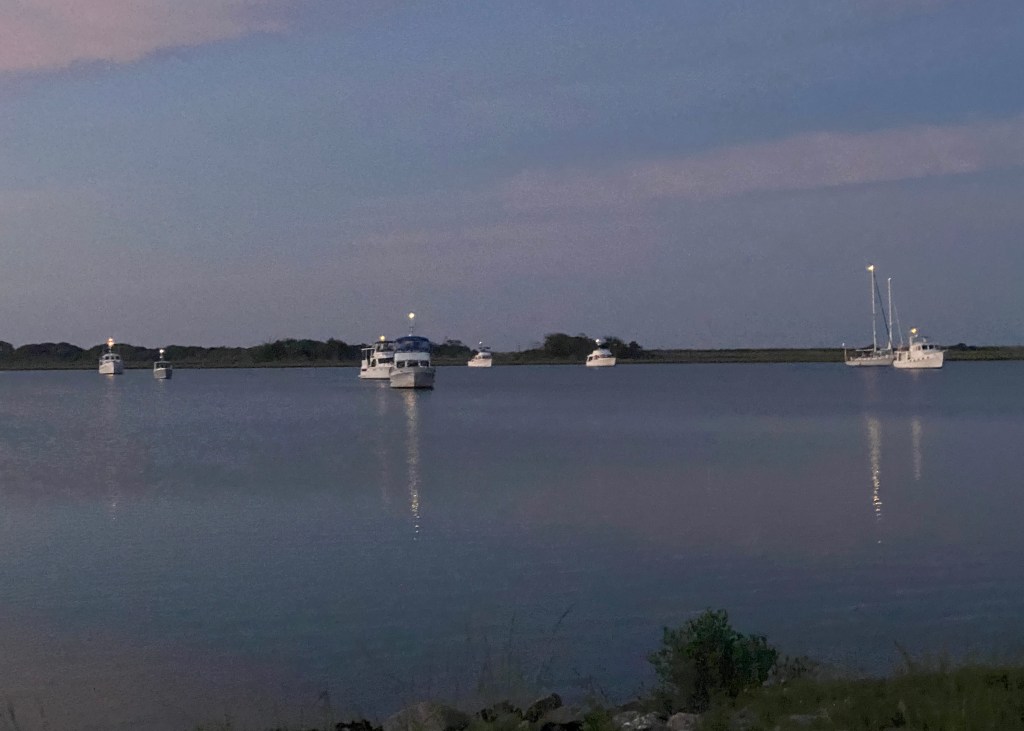
For the first time in many months, our anchor light is burning brightly. There are eight or ten of us tucked in here for the night, four miles south of the Onslow Bridge which will open at seven and not again til noon.

It will be an orderly evacuation at dawn. No confusion. There are rules. And radios. Because avoiding confusion is indeed the most important thing.