We left Bluewater Safe Harbor Hampton today after three rainy, windy days at the dock.
While we were there, Katie loved the long bike ride all three of us made along Chesapeake Avenue between rain showers. She loved being off-leash around the marina, until she discovered rabbits and I had to crawl through condo shrubs where she’ dropped her last ball in pursuit of livelier prey. After that, I was more judicious with tethering her where temptation existed.
She reined herself in enough to have a swim at a nearby boat ramp plus a few go-fetch outings at a huge, vacant, lush and grassy lot the marina manager also managed. After Katie won him over at the marina office, he generously gave us carte blanche to use it.
*
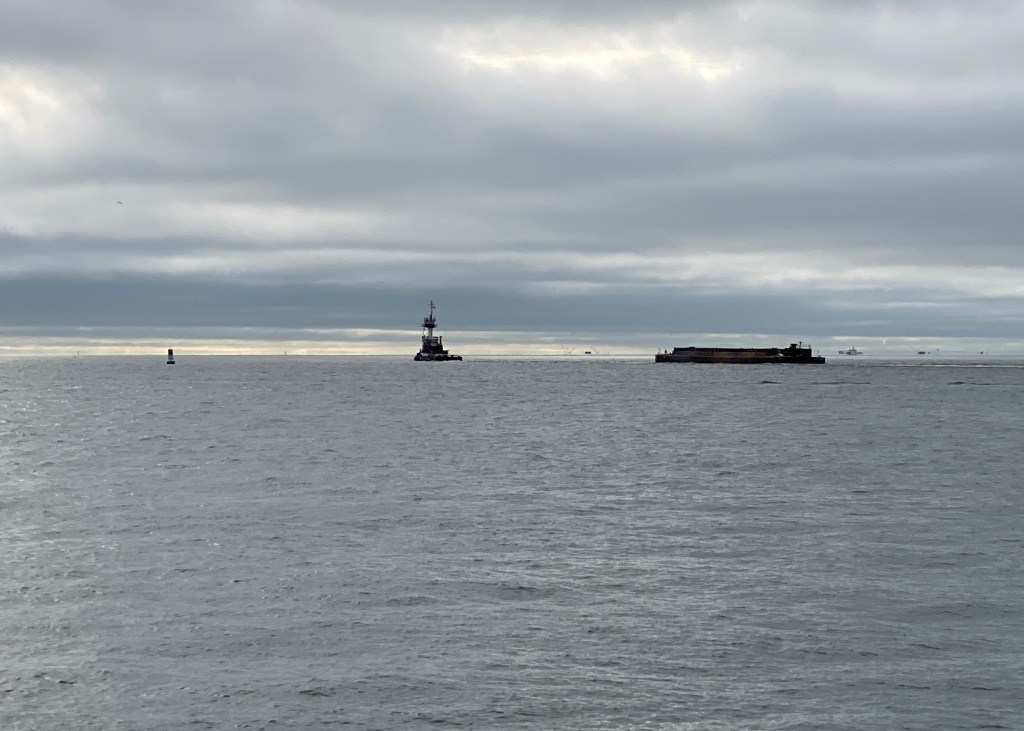
This morning we stood into the Chesapeake Bay. Tons of interesting traffic transits between Point Comfort and Fort Wool, a mile-wide passage over the Hampton Bridge Tunnel and under the I-64 Bridge: Navy and container ships, tug-and-barge combinations, sport fishers, cruisers, power boats, sail boats, fishing boats.
Inbound vessels headed for the Naval Station, port terminals, and marinas are maybe glad to be in sheltered waters. Outbound vessels stand into the Bay to turn north toward Annapolis and Baltimore or east toward the Atlantic.
The Chesapeake is the largest estuary in the US and formed by the drowned valley of the Susquehanna River. The Susquehanna is one of the world’s oldest continuous rivers, about 450 million years old and going strong.
Seas picked up a little as we turned north. Virginia’s Eastern Shore was too distant to see.
*
Pete and I stood watch two (hours) on, two-off. The sun peeked out then ducked under again. Katie snoozed on the bench. The day was uneventful. As I drove I considered the term standing into.
Stand implies a fixed or stopped position. As in when the tide stands at slack water, those few moments or minutes when water has stopped horizontal movement. The Bay is 200 miles long – long enough tides rise and fall vertically at different times and rates at different locations; its tides and tidal currents are a factor in vessel speed over ground.
The idea is to time travel to catch a swift current heading with – or at least not working against us. We’d prefer to reach difficult channels or docks at slack tide. Like most human affairs, it feels better to ride the tide than to buck it, and take a stand without being pushed around. In a boat, this makes sense. In human affairs, not always.
*
Standing into has a different meaning: a continuous posture (standing) moving toward something (into). More is happening. Hopefully you know your destination. Or, for example, if you are standing into danger or difficulties, you recognize the situation before it is too late.
*
The radar is still down. Repairs are on hold until a twenty-dollar antenna-turning belt arrives. Fortunately we have had clear weather and always use AIS as do many local vessels (and all commercial vessels).
The wind was low today so the few sailboats we encountered were motoring in a straight line, which always makes life easier for us. As always, we were in loose company with other northbound cruisers.
*
By 1600 IH was standing into Ingram Bay. The channel was well marked, if shallow. Chesapeake fisheries are legend: shellfish — crab, and oysters — but also menhaden and striped bass. We approached the marked channel dodging pot floats and fish traps.
The marina had the ambiance of a small operation that hadn’t changed much in decades. I easily imagined a snapshot from the 1960s would not show much difference. A brick fireplace had logs in a teepee ready to light. Six or eight kayaks were neatly stacked on a livery trailer. Most of the docked vessels were sailboats.
*
Katie stayed out of the water after I noticed child-fist-sized stinging jellies drifting around. But the rural marina was surrounded by huge, mowed, fallow fields. They reminded me of Ohio (except for the adjacent Bay).
She ran to her heart’s delight until one of those amazing new creatures – a bunny — caught her eye. I estimate she ran a quarter mile before she turned back. She was gone less than three minutes but still earned leash time-out until dinner. She did a better job of sticking close later in the evening.
*
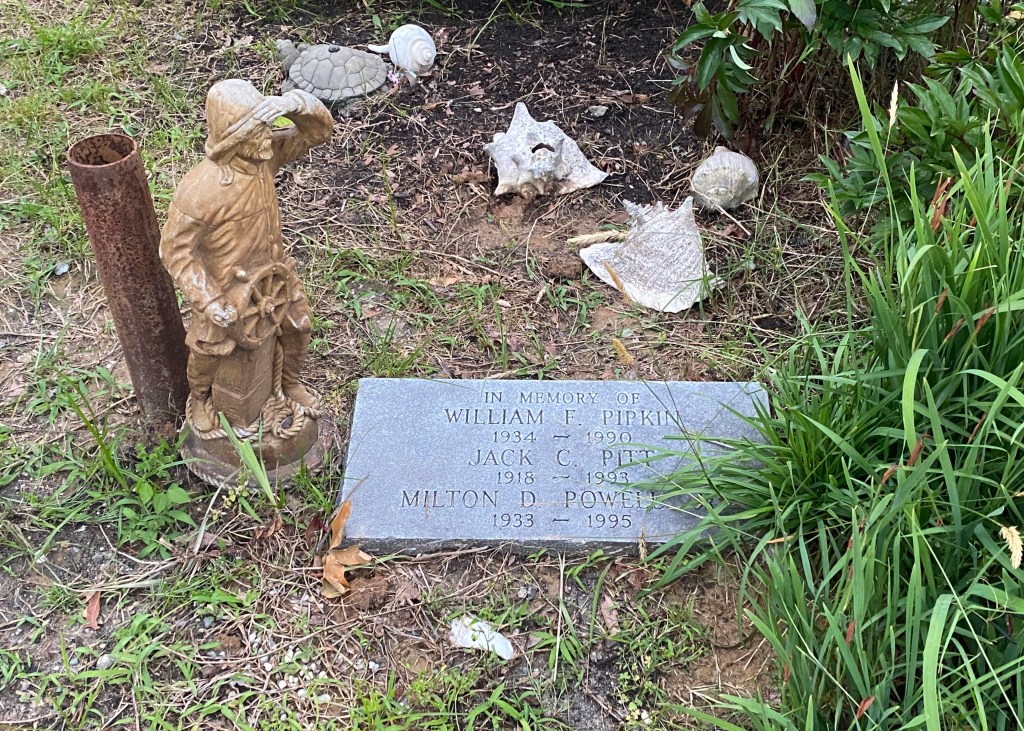
While Katie and I walked around, I spied a fake road sign. It showed a lanky, stooping fisherman in silhouette, wearing a hat and carrying a rod. It said CAUTION: OLD FISHERMAN. A few minutes later I saw a marker and dockside shrine to men I imagine haunted the dock and still haunt the dock at Ingram Bay Marina.
I have already lived more years that William or Milton. I hope to outlive Jack. I’d rather not be standing into the afterlife any time soon.
Tomorrow we have a 100-mile day but plan to reach our new home port at Kent Island. Fingers crossed.
 Irish Hurricane