Last night we had a quiet dinner in Beaufort’s very loud Mazcalito Restaurant. Pete and I are too engine-noise deaf to wander into so much noise and still expect to converse. The company was still good, as was a fat plate of shrimp-and-pork-nugget supreme nachos we four shared, and frosty 22-ounce mugs of Dos Equis XX beers for the men.
*
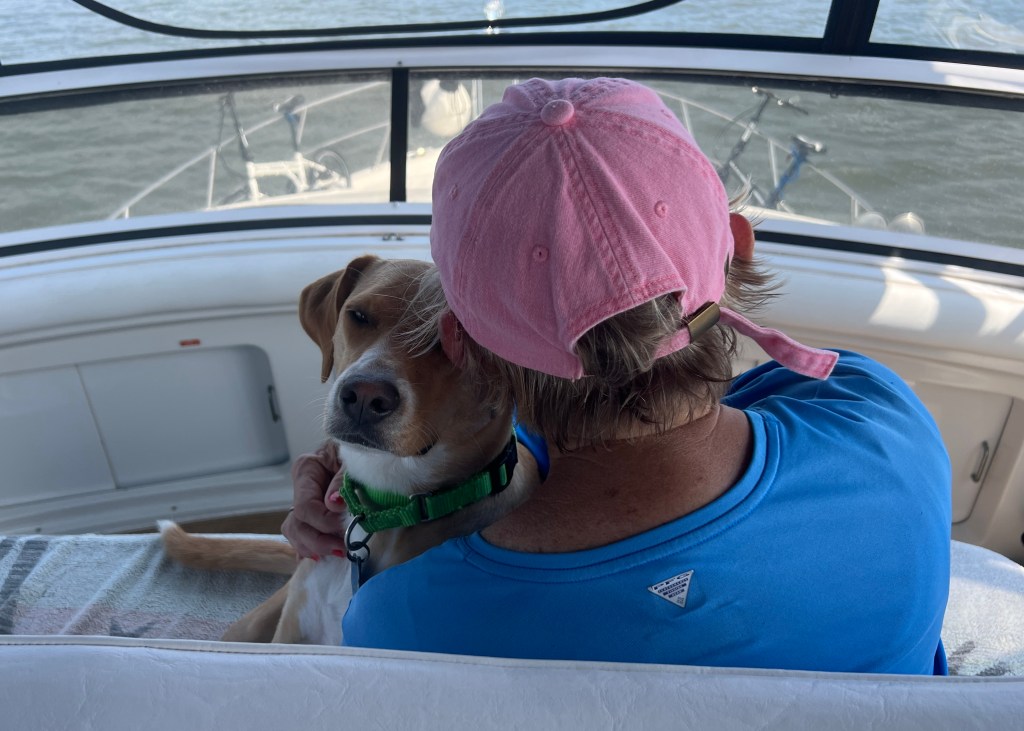
Katie got her morning walk down Ann Street today. We stopped at a smaller yet spacious park where she fetched a few balls. Pete pointed out Beaufort’s unique up-and-down picket fence style, which has something to do with the town’s archaic hog ownership laws. I couldn’t figure out how the two relate.
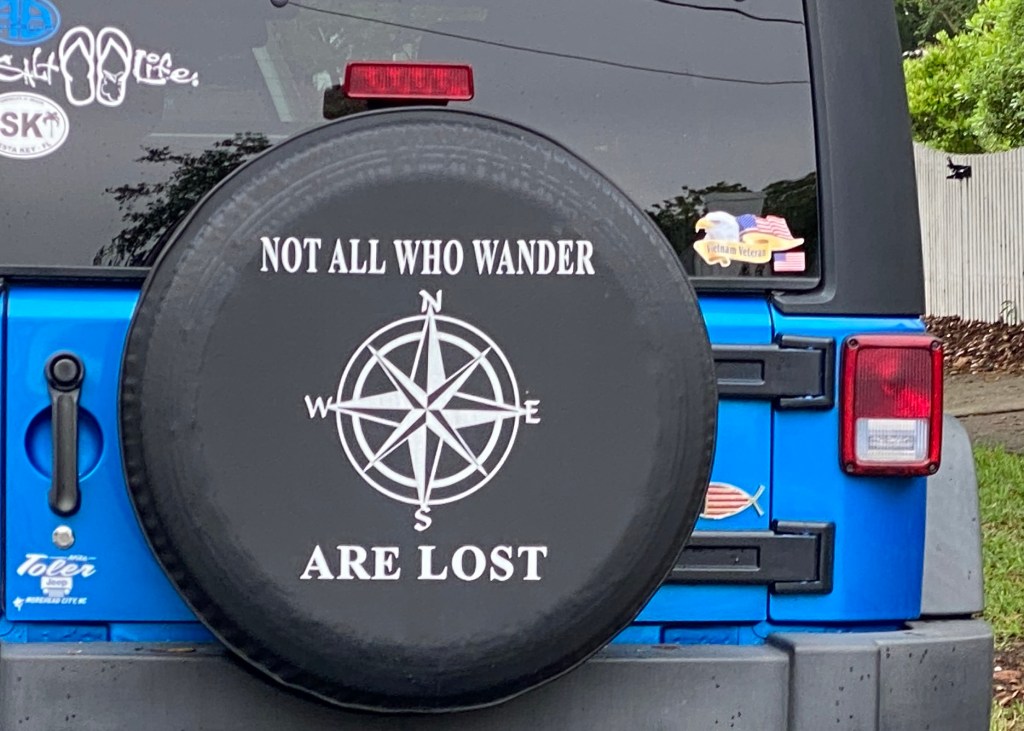
On return to the boat, I spotted a sporty blue vehicle with a spare-tire cover opining, Not All Who Wander Are Lost. Which caused my mind to wander. And wonder.
*
Wander: to move in a leisurely, casual, or aimless way
Wonder: to desire or be curious to know something
(I Wonder As I Wander is John Jacob Niles’ 1933 adaptation of an Appalachian folk hymn. Niles first heard the hymn in Murphy, North Carolina, sung by the daughter of a Revivalist family that was trying to make ends meet during the Depression.)
*
Life aboard Irish Hurricane is rarely leisurely: lines, shore ties, miles of walking and hours to accomplish what we’d otherwise achieve in a car or by Amazon.
Casual doesn’t seem appropriate. Nor is aimless a good description of our travels; it does not seem to apply because in fact we wonder as we go. Wondering is curiosity’s first step, the thing that leads you to question and think. Thinking is work. It is not aimless.
I agree with the sentiment, though. Not all who wander are lost. Though, not all who wander are not lost, either.
The quote comes from J.R.R. Tolkien’s poem about Aragorn aka Strider, the Ranger of the North. He joins forces with Frodo, Gandalf, and the Fellowship to defeat Sauron, who would destroy the world for his own power-hungry ends.
All that is gold does not glitter. Not all those who wander are lost.
The Internet tells me the poem’s deeper meaning is this: a journey should have a purpose.
Mine is to cultivate empathy. To learn the ways that other people in foreign cultures (domestic or not) are solving the problems of living. To see that most of us are doing the best we can with what we have.
To see that I might behave the same way under similar circumstances.
*
By the time I realized this morning that we were a mile past Hammock House, it was too late to double back for a photo — we had a date with the fuel dock for sewage pump-out, and wanted to leave Beaufort in time to reach Oriental before winds kicked up the Neuse River.
Google Hammock House. It is a West Indies-style two-story that is claims to be the oldest standing house in Beaufort and maybe North Carolina. Early maps call it “the white house”.
Blackbeard purportedly headquartered at the White House for a while. They say he hanged a young French concubine after he forced himself on her. He was in a fit of rage. They say you can still hear her ghost screaming.
*
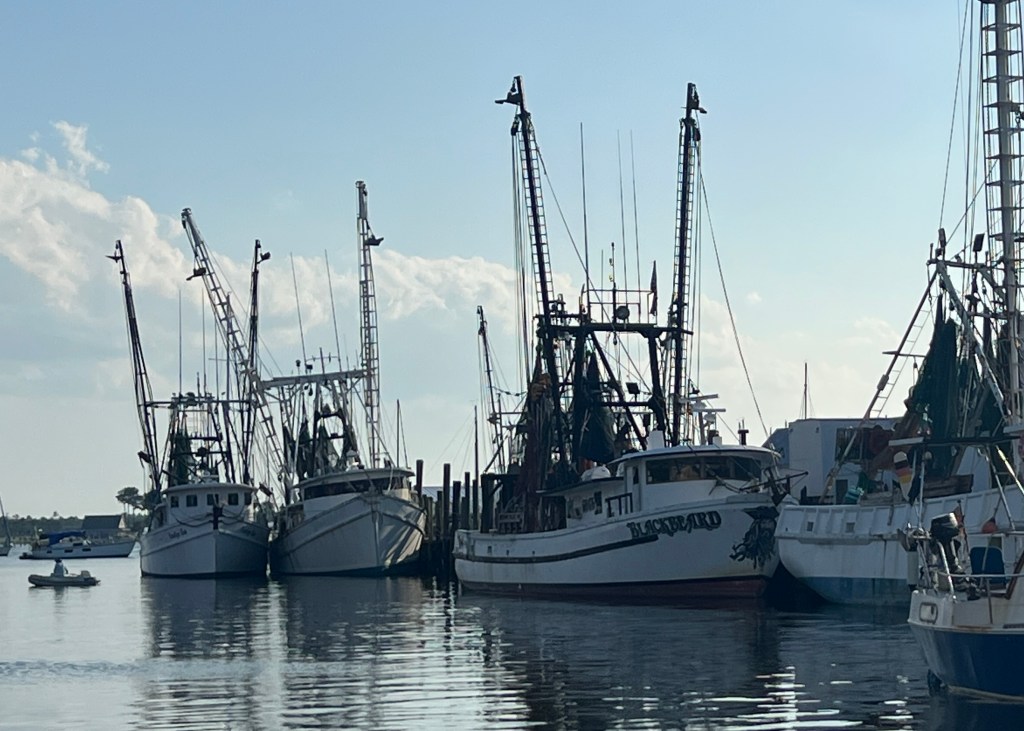
Here in Oriental, where IH is docked for the night, Pete spied a more modern Blackbeard, one of Oriental’s large shrimp fleet. Tomorrow we’ll look for fresh seafood before getting underway.
 Irish Hurricane