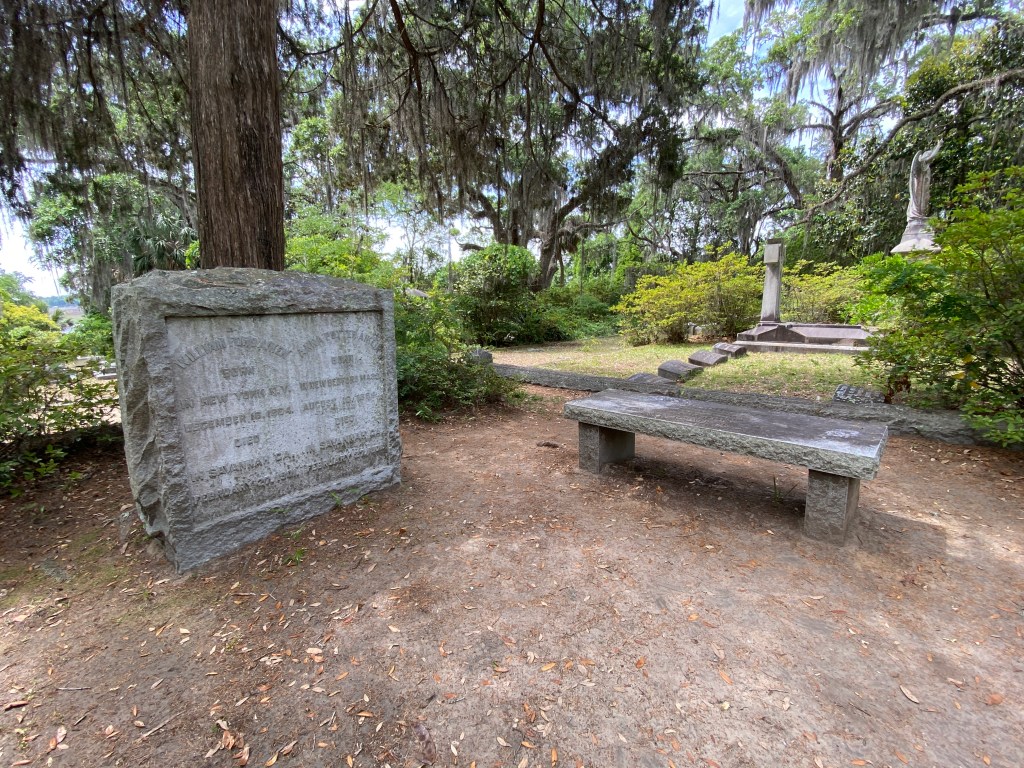
The Bonaventure Cemetery is a mile away from the marina. It’s on the National Register of Historic Places and worth a visit for its natural beauty- oaks and river bluffs; its statuary – angels, a 6-year-old Victorian girl named Gracie, and the Bird Girl made famous by John Berendt’s novel of Low Country voodoo and intrigue, Midnight in the Garden of Good and Evil; and its luminaries.
Georgia’s first Governor is buried here – Edward Telfair, Founding Father who also signed the Articles of Confederation, forerunner to the modern American Constitution.
The Articles didn’t work very well. According to Google’s AI, their down sides included a central government with no mechanism to levy taxes that left our young country with outstanding debts dragging it down; no national court system, which led to a law enforcement nightmare; and “difficulties in regulating interstate and international trade” that led to economic instability.
*
But I digress. Bonaventure’s luminaries also include songwriter Johnny Mercer, and writer Conrad Aiken – plus 30,000 other souls who were luminaries to someone, I’d like to think.
Telfair died at age 71, in 1807, thousands of miles from his native Scotland – his remains were moved to Bonaventure from the family’s plantation in the mid-19th century.
Johnny Mercer was the son of a prominent Savannah attorney/ real-estate developer. He died at age 66 from an inoperable brain tumor. He was living in LA; his body was shipped home. He’d once been in love with Judy Garland.
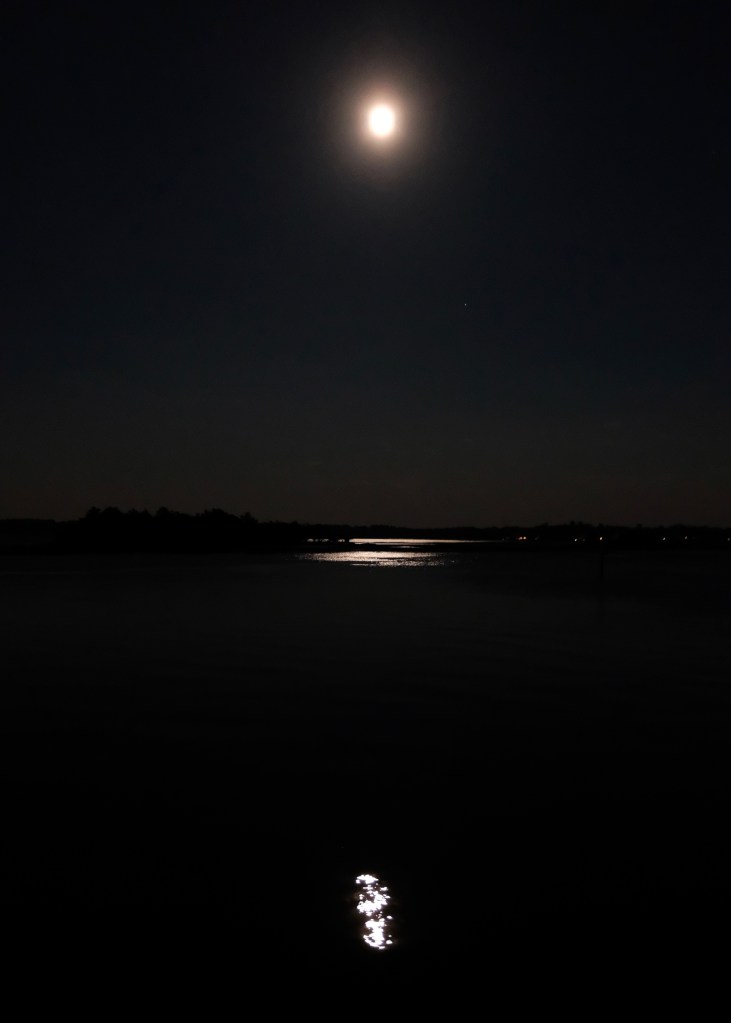
Mercer wrote the lyrics to the classic, Moon River. The song expresses longing, such as might have been felt by orphans living in the Bethesda Orphanage near the actual Moon River that winds along south of Savannah – in 2019 I caught a photo of the moon rising near that famed waterway.
The Orphanage is now a private prep school for boys. The orphans, long gone.
Conrad Aiken was a Pulitzer Prize winner and onetime US Poet Laureate whose writing can be so dark that Sigmund Freud reportedly once volunteered to psychoanalyze him. Aiken’s father committed a murder-suicide on himself and Conrad’s mother when the boy was 11. I guess that would do a number on anyone’s worldview. Aiken died at age 84 in Savannah, where he was born.
*
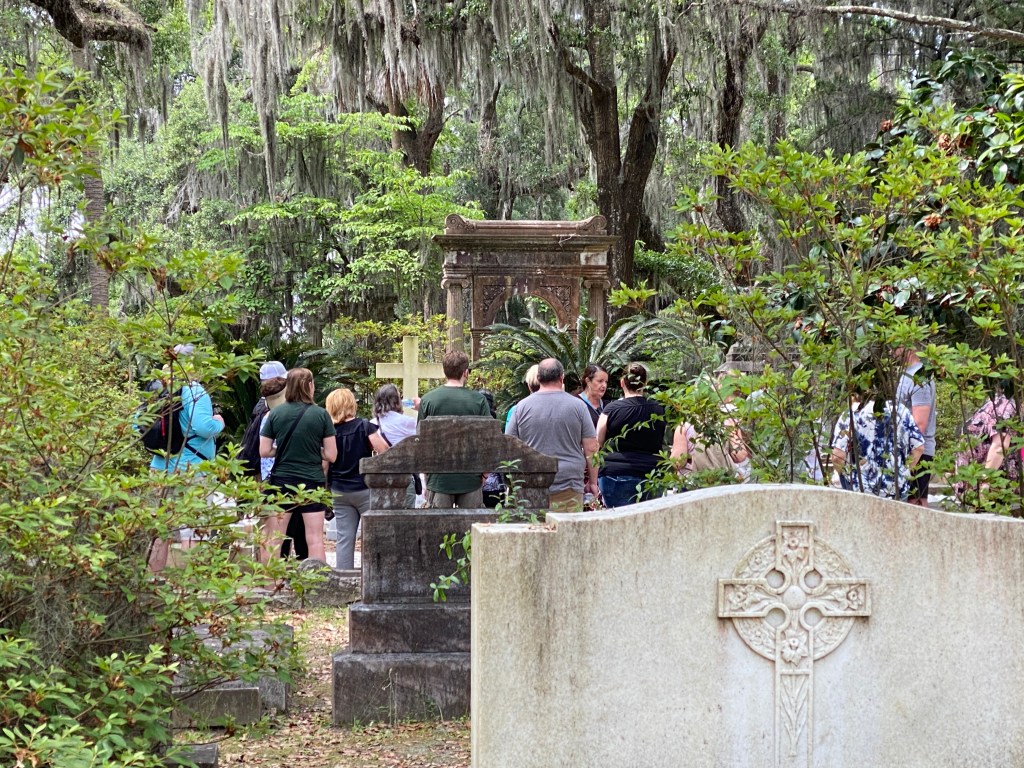
Today Pete, Katie, and I pedaled along the Wilmington River bluff in company with thirty thousand ghosts and a few tourists – groups on foot with guides, and others riding in golf carts with presumably higher-priced guides. Because we had Katie, I missed photographing Johnny Mercer’s grave, though I like the photo I could get, which is of a tour group listening to ghost stories.
Why do we do it?
Listen to stories of death, visit graveyards, look for ghosts? Are we trying to learn invisible ropes that soon enough, we’ll have to use? Or are we reading death like Daily Inquirer supermarket headlines – the crazy things people do that will never happen to us.
Here’s a nice line from Conrad Aiken’s classic, The Charnal Rose, in which his everyman Senlin considers the meaning of life. I had to look up charnal: it’s an ossuary, a place where corpses or bones are deposited, or an adjective describing something that is death-like.
A death-like rose. A boneyard. In the poem, Senlin wonders whence he came – and I suppose whence he will go.
Perhaps I came alone on a snow-white horse,
Riding alone from the deep-starred night.
Perhaps I came on a ship whose sails were music,
Sailing from moon or sun on a river of light.
*
Which reminds me of Johnny Mercer’s even better words:
Moon River, wider than a mile,
I’m crossing you in style someday
Old dream maker, you heart breaker
Wherever you’re going, I’m going your way
Tomorrow we’re on our way again, to Hilton Head. The three of us aboard Irish Hurricane – wherever she’s going, we’re definitely going her way.
 Irish Hurricane