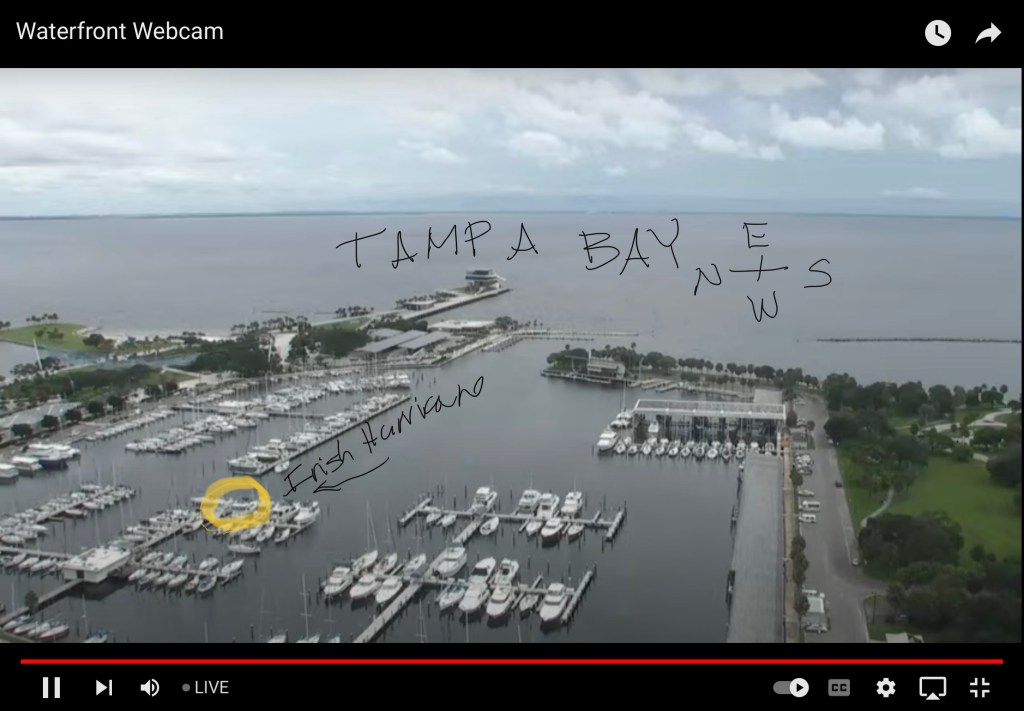

We moved aboard full time in June 2022; our longtime St. Pete home sold a month later. The good news about having no “dirt home” is you don’t have to take care of it. The bad news is, it’s not there to take care of you.
My rotator cuff was repaired in mid-August. I might have been able to stay aboard IH during those first weeks of intense pain and immobility, but St. Petersburg Municipal Marina, our home dock, was a fixed structure. The tides put our swim platform or boarding step level with the dock only about a quarter of the time; otherwise, boarding required a big step and hand up (or down).
Without a house, we needed an AirBnB recovery rental. So, while I was thrilled to be out from under house/ lawn/ pool care, I was less enthusiastic about living in a costly, cramped BnB.
By September, though, we were back aboard. Sling and all, I managed to get underway twice – for a quick yard haul-out and return. St. Pete is about halfway up Tampa Bay — about 20 miles from the entrance — in Pinellas County, which is a peninsula bounded by the Bay and the Gulf of Mexico. The yard trip took us down the Bay, under the Skyway Bridge, and into smaller Boca Ciega Bay.
The yard trip was a test of my seaworthiness. We’d hoped to take IH to Fort Myers in mid-September for a week or so – family wedding, fun times, afternoon cruises – but decided last-minute my shoulder was still too fragile and a two-hour drive beat a three-day cruise with my arm still in a sling. I reluctantly cancelled our reservation at Legacy Harbour.
On Friday 9/23, we locked the boat, hopped in the car, and headed south for the weekend. The hurricane map Floridians constantly watch showed nothing but a small tropical wave in the Caribbean. We were good to go.
We had a fine time seeing family and friends the next day.
But Sunday morning, we awakened to National Weather Service warnings that a lethal Category 5 hurricane was heading for Tampa Bay. We looked at the “cone of death” with disbelief — hurricanes traditionally don’t pop up like afternoon thunderstorms, yet satellite images showed how quickly the massive heat engine was gathering moisture, windspeed, and forward motion.
We take hurricanes seriously, including storm surge predictions. We’ve lived in the Southeastern US and Caribbean for decades and know hurricanes are not to be messed with. Hurricane danger lies more in the water it pushes and drops than the wind it generates. As well, the storm’s aftermath demands at least as much consideration as its passage.
Clearly, Ian would cause catastrophic damage wherever it came ashore. So, while we knew the forecast would be refined in the next few days, we headed back to St. Pete to prepare ourselves and Irish Hurricane for a worst possible case.
All the way home, we kicked ourselves for having driven the car instead of taking the boat to Fort Myers. “Dang. We could’ve sat the whole thing out at Legacy,” I complained. I love the boat and love to have family aboard. It seemed that we should have cruised south after all.
I checked my phone’s radar and Windy apps. Irish Hurricane lay directly under the storm track. We waited for the hurricane hunter update with crossed fingers, but like most things in life, you have to best-guess your plans based on experience and current facts.
It was sunny and windy as we drove up I-75, crossed the Sunshine Skyway, and made our way downtown. We made checklists as we drove.
Our household goods were already in storage on high ground in Tampa. Valuables we kept aboard IH needed to be gathered, and extra fenders and lines deployed. Loose gear needed to be stowed and photos taken of every space and piece of equipment from the engine room, to the insides of cupboards and drawers, and to show how we’d secured the boat to her moorings.
I did the light work as my tender shoulder permitted. I assembled a go-box no differently than we otherwise would have done, including papers, passports, hard drives, photos, medications, and a few irreplaceable sentimental items. I took photos with an eye to the insurance claim we assumed we’d be making in a few short days.
A 12-to-17-foot storm surge up Tampa Bay would devastate the entire urban area. (Count your blessings if you’ve never seen or worse, lived through a hurricane and its destructive aftermath.) If the predictions were accurate, nothing would be recognizable, or maybe even remain, after Ian had his way.
Meanwhile, Pete buffered the hull from the cement dock and wooden pilings to which IH was secured, using every fender we owned. He added extra mooring lines and doubled them all.
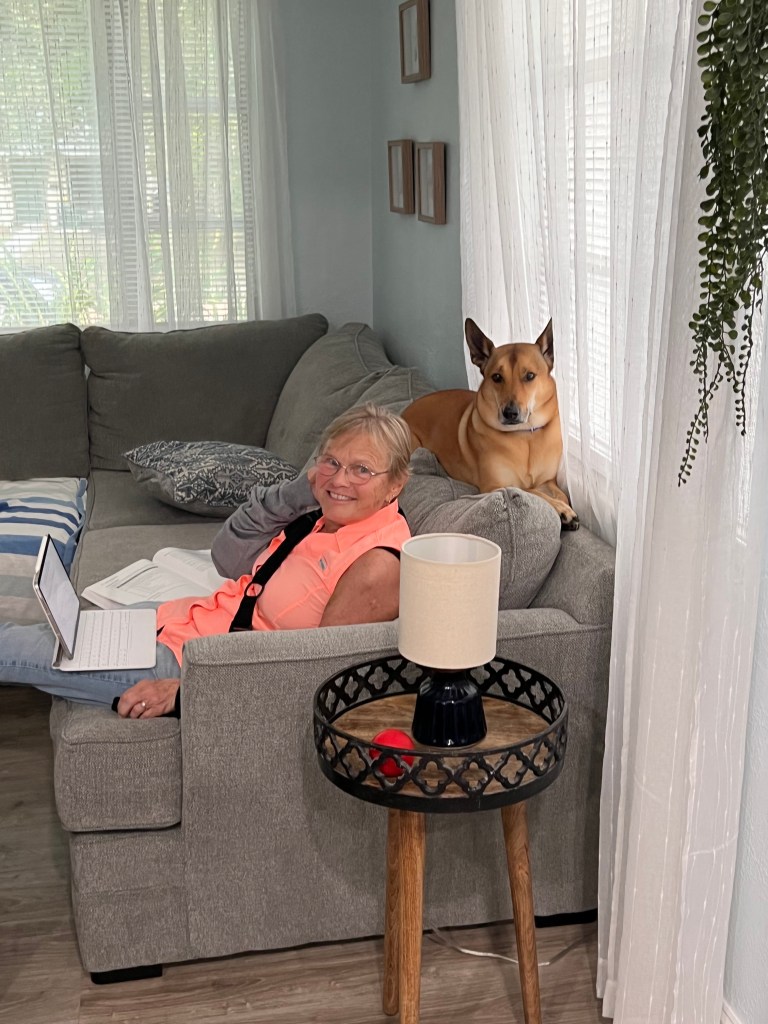
I gathered foodstuffs and tableware, assuming wherever we landed may be short on open restaurants, and those would be struggling to serve long lines of evacuees. I pulled together Looper’s things – food, toys, bedding, and leashed.
On the dock, we chatted with fellow boaters. who were making similar preparations to the power boats on our seaward side of the dock and to the smaller, lighter sailboats opposite. People were shuttling belongings to cars backed into the marina’s loading zones, and stopped to discuss mooring line strategies and trade phone numbers.
The weekend boaters were removing valuables and doubling lines. Some liveaboards planned to stay put as the storm passed. Others would stay with friends or check into downtown hotels. We booked reservations seventy miles away at a pet-friendly hotel. We notified the marina office we’d complied with mandated preparations, and where we’d be as Ian passed.
We packed the car as much as possible, ready to leave in the morning. Then, like millions more, we began bingeing weather news: Baynews-9 storm updates “on the 9’s” and The Weather Channel where Jim Cantore and his colleagues were reporting to windy or dead calm beaches from Key West to Florida’s panhandle. We constantly checked our weather apps and marveled at the storm’s rapid intensification while trying to guess its track.
We walked Looper around 2100. The night was stifling hot, humid, and still — the proverbial calm. Across the street in Straub Park, homeless folks were being gathered for evacuation inland. Traffic was light at the normally bustling Pier Complex.
I looked around at St. Petersburg’s beautiful old live oaks and banyans, its lovely waterfront and Beach Drive storefronts. I knew it could all be destroyed in a few short hours. I hoped the storm would turn and strike elsewhere, even as I knew that if it did, our good fortune would be someone else’s destruction.
We are all so helpless, I thought. The sea, sky, and weather teach us that lesson when we’re young, and reinforces it every day. I don’t think any of us slept well that night as we tossed and turned, listening for the wind to shift, and anticipating the uncertain future.
 Irish Hurricane